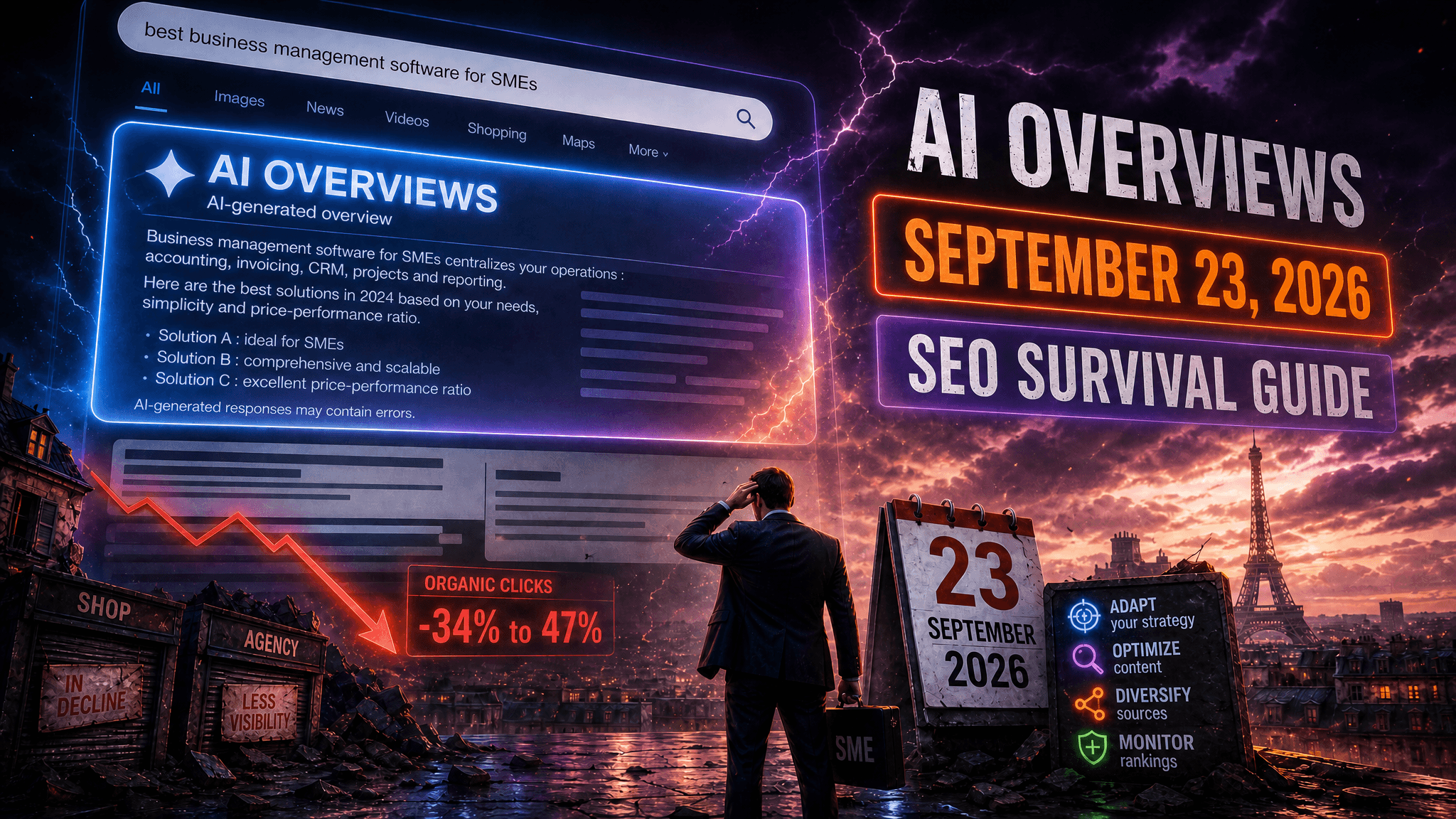
Google has confirmed the deployment of AI Overviews in France before September 23, 2026. In six years of SEO, nobody has seen anything like this. HubSpot just lost 44% of its traffic on stable keywords, B2B tech saw 82% of its queries switch to AI Overview, and one user in four stops browsing after reading the AI summary. Here's what awaits you concretely, and above all how to respond methodically.
The countdown that should terrify every SMB leader
On June 29, 2026, Google sent an official letter to French press editors formalizing something suspected for three years without daring to believe: AI Overviews and AI Mode will arrive in France before September 23, 2026. The information was reported by Ouest-France, then confirmed by Les Échos and Le Monde.
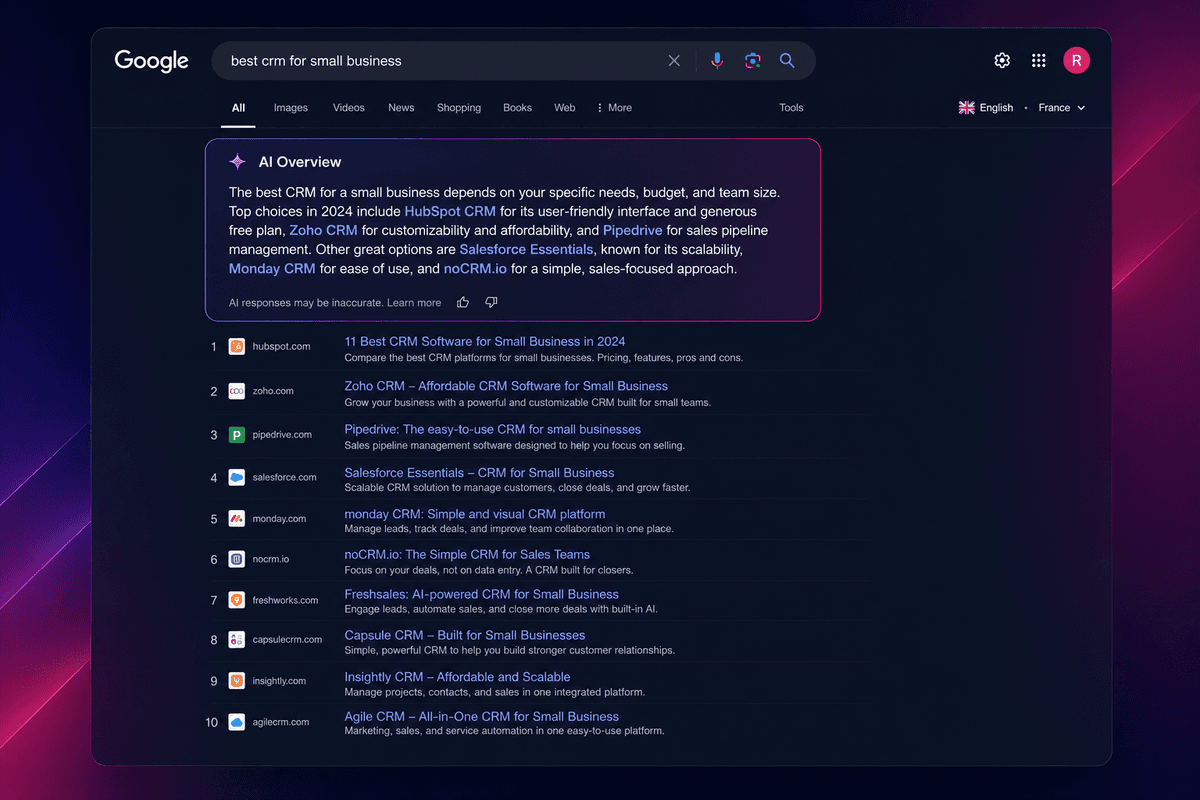
Concretely, what does this mean? In the coming weeks, Google will display above French search results AI-generated summaries that directly answer user questions, with a few links below (often 3 to 5). The classic SEO user experience of the ten blue links will disappear for a growing share of queries.
Why France was spared until now
France's delay is neither technical nor linguistic. AI Overviews has been working in French with our Belgian and Swiss neighbors since 2025. The blocker was strictly legal: French law from 2019 on related rights requires Google to compensate press editors for the exploitation of their content. And the French Competition Authority imposed a record fine of 250 million euros on Google in March 2024 on this subject.
At the end of June 2026, an agreement was reached. Google made three commitments to French editors: a right of withdrawal (opt-out), transparency on impressions generated by AI, and compensation under related rights for content included in AI responses. The last lock is lifted.
The precise timeline to remember
June 29, 2026: official announcement by letter to editors
Summer 2026: gradual deployment in France
September 23, 2026: deadline confirmed by Google
Fall 2026: dedicated Search Console reports for AI Overviews, available since June 2026
By the time you read these lines, you have between 4 and 10 weeks to prepare your site. It's not an eternity, but it's enough if you know exactly what to do.
The real numbers of AI Overviews impact: the authoritative studies
Before selling you a method, we owe you the numbers. Not those of alarmist articles, those of rigorous studies. Here's what we really know about the impact of AI Overviews in already equipped markets.
The HubSpot study analyzed by Ahrefs (July 2026)
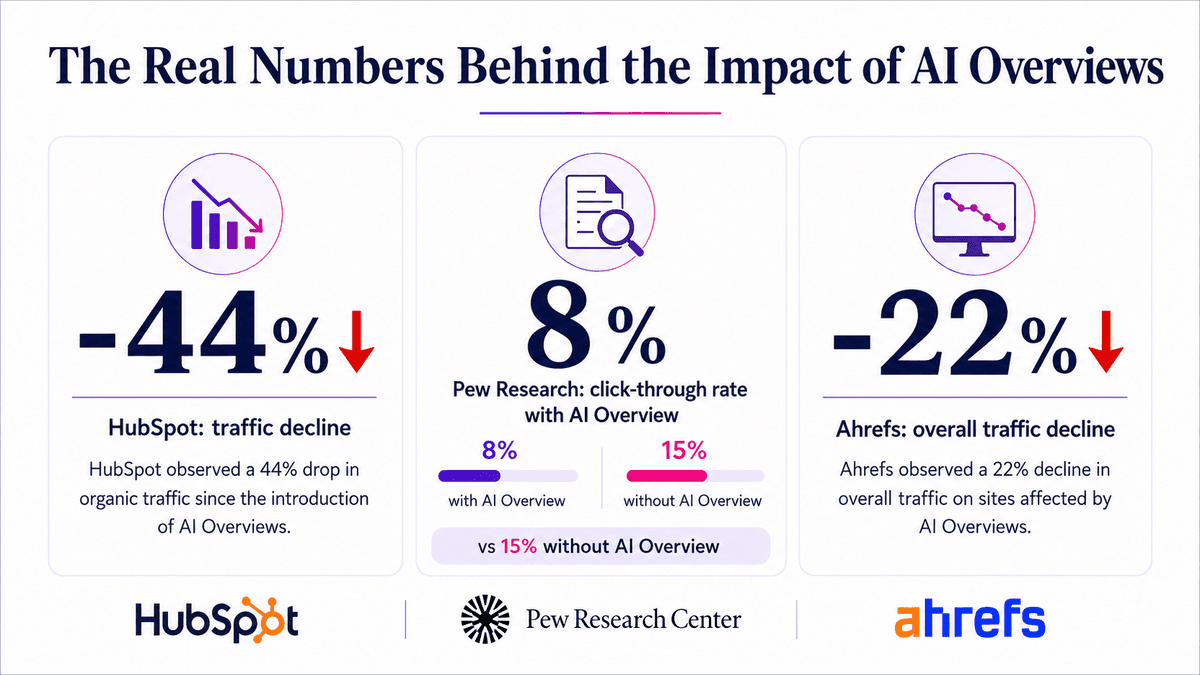
This is the most solid field evidence we have today. Ahrefs analyzed HubSpot traffic in early July 2026 on three already equipped markets (Belgium, Switzerland, Canada). The result on 554 keywords with strictly stable ranking over one year: traffic dropped by 44%, from 3,481 to 1,932 monthly clicks.
This is not a downgrading. Positions were stable. It's a pure loss of clicks, attributable solely to AI Overview. The breakdown by blog theme is even more telling.
Sales blog (type "what is a B2B sales funnel"): -50% clicks
Marketing blog (type "how to calculate marketing ROI"): -48% clicks
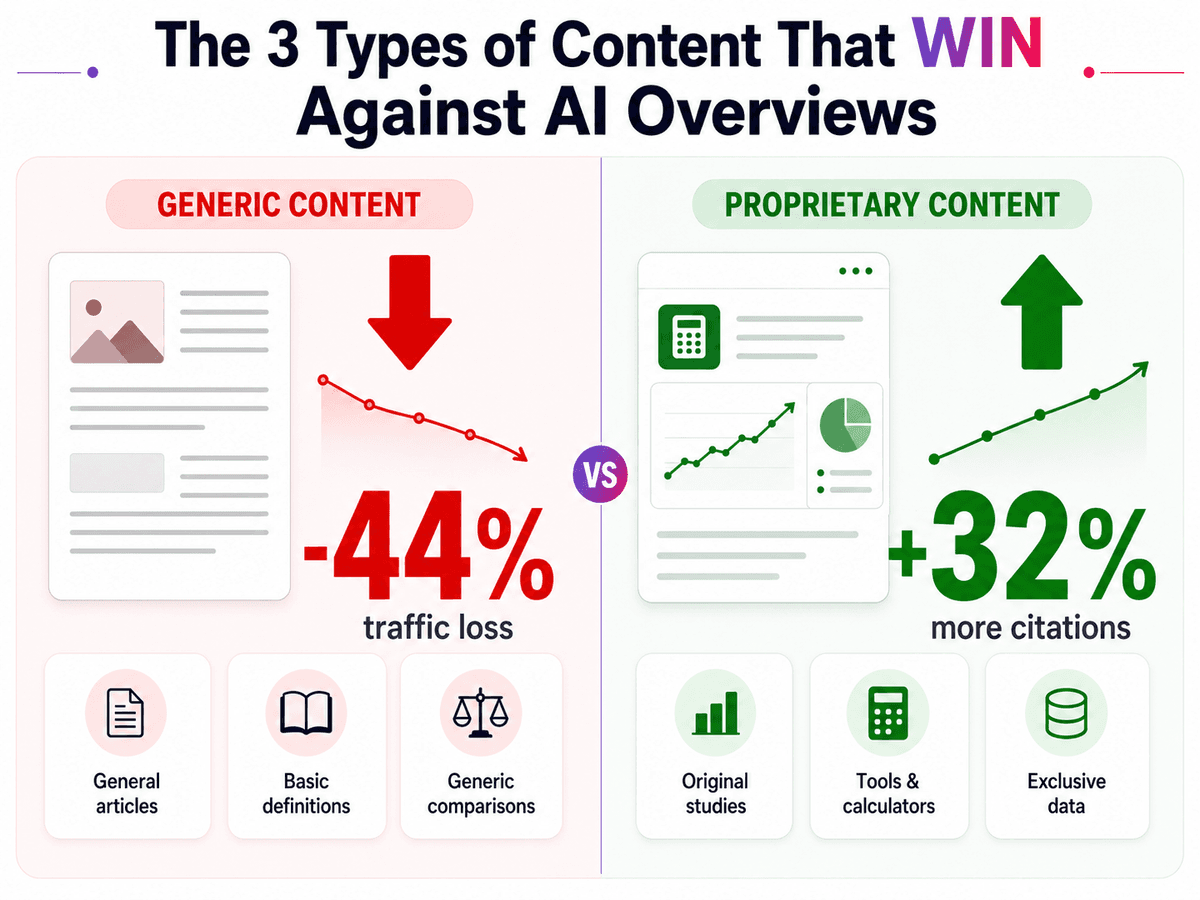
Product pages and free interactive tools: +32% clicks
The Pew Research Center study
On approximately 69,000 analyzed searches, Pew Research Center measures that only 8% of users click on an organic result when an AI summary appears, compared to 15% in classic search. Even more troubling: 26% of users simply stop browsing after reading the AI summary, never visiting any site.
The Ahrefs tracker on 300,000 keywords
Ahrefs' tracker, which aggregates more than 75,000 sites monitored by professionals, measures a macro effect of -22% traffic sent by Google between June 2025 and May 2026 on equipped markets. And on position #1 facing an AI Overview, CTR drops by 34.5% on average.
The academic experiment providing causal proof
A randomized experiment conducted by the Indian School of Business and Carnegie Mellon, published in early 2026, provides the causal proof that was missing: removing AI Overview brings outgoing clicks back up by 38%. It's not a correlation, it's a causality measured in a laboratory.
Sectoral progression measured by BrightEdge
Some sectors are more exposed than others. BrightEdge measured the evolution of the rate of queries triggering an AI Overview over one year.
Health: 88% of queries display an AI Overview
Education: 83% of queries
B2B Tech: shift from 36% to 82% in one year, one of the most marked sectoral jumps
E-commerce: only 4%, good news for this sector
If you're a B2B tech or services SMB, you're on the front line. If you're an e-commerce, the impact will be minimal initially.
The 3 types of content that lose the most, and why
Not all pages are equal in the face of AI Overviews. To understand what will happen to you, you first need to identify which content Google prioritizes summarizing in its AI overviews.
Generic explanatory content
Articles like "what is X", "how Y works", "the 5 steps to Z" are exactly what Google loves to summarize. These are structured, factual content, easy to extract. Result: they are massively absorbed into AI Overviews without the user needing to click.
At HubSpot, these are the contents that lost 48 to 50% of their traffic. If your content strategy relies on this type of article to generate top-of-funnel leads, you're on the front line.
Generic tool comparisons
Articles like "X vs Y", "the 10 best tools for", "solution comparisons" are also privileged targets. Google summarizes them in a table or list in the AI Overview, and the user gets their answer without ever visiting your site.
Unless your comparison contains data that Google can't produce itself. We'll come back to this below.
Unstructured FAQs
Simple questions and answers presented in prose, without Schema.org markup and without clear structure, are easily extracted and summarized by Google. They feed AI Overviews without generating clicks to your site.
Paradoxically, FAQs well structured with Schema.org FAQPage are much more likely to be cited as sources, which stays positive for your brand visibility.
The 3 types of content that win against AI Overviews
Facing this reality, the good news is that three types of content resist or even progress against AI Overviews. It's on these formats that you need to shift your editorial strategy.
Experiential content with field proof
Google systematically favors content that provides verifiable real experience. Detailed feedback, quantified case studies, authentic client testimonials, screenshots of concrete results. These are the only content that Google cannot summarize without explicitly citing the source.
The E-E-A-T criterion (Experience, Expertise, Authoritativeness, Trustworthiness) becomes decisive in 2026. The first E, Experience, takes on decisive importance in the face of generic AI content.
Proprietary data and original studies
Exclusive figures, industry benchmarks, field studies, statistics no one else has. This content becomes sources cited by AI Overviews, giving you new brand visibility. Unlike traffic that decreases, citation by an AI Overview can strengthen your perceived authority.
Concrete example: when an AI Overview cites "according to a Synerium 2026 study on 400 French SMBs", you exist in the response even if the user doesn't click. It's a new form of branding.
Interactive content: calculators, tools, configurators
At HubSpot, these are the only contents that progress against AI Overviews: +32% clicks on product pages and free interactive tools. For a simple reason: Google cannot summarize a calculator in an AI Overview. The user must come to your site to use it.
Think ROI calculators, quote configurators, quizzes, simulators, generators. These are your best weapons for capturing qualified traffic in the post-AI Overviews world.
GEO (Generative Engine Optimization): the method that extends classic SEO
The acronym GEO (Generative Engine Optimization) is emerging as the new standard. It refers to all techniques that allow content to be cited by AI answer engines (Google AI Overviews, ChatGPT Search, Perplexity, Claude, Gemini). It's not a renaming of SEO, it's a necessary extension.
Structure responses in quotable blocks
Each section of your content must be able to be extracted and cited independently. Concretely: a clear H2, a direct answer in the first 100 words of the section, verifiable sourced facts, a synthetic conclusion.
Format to favor: question asked in the title, direct answer in the first paragraph, development in the second paragraph. This is exactly the format Google loves to extract.
Massively strengthen Schema.org markup
Structured data becomes critical. The most useful schemas to be cited by AI Overviews:
- FAQPage for questions and answers
- Article with identified author (E-E-A-T)
- HowTo for practical guides
- Product for product sheets
- Organization to identify your brand
- LocalBusiness for local SEO, which remains effective
Multiply E-E-A-T signals
E-E-A-T stands for Experience, Expertise, Authoritativeness, Trustworthiness. In 2026, these signals become determinant for being cited by AI. Concretely:
- Identified author with detailed biography on each article
- Certifications and visible references
- Links to LinkedIn profiles of authors
- Brand mentions and backlinks from authority sites
- Client reviews structured in Schema.org Review
- Dated updates: Google favors recent content
Build topical authority through semantic clusters
An isolated article, however excellent, will have little chance of being cited. It's the whole of your content on a subject that builds authority in the eyes of AI. The principle: a very complete central pillar, surrounded by satellite articles that deepen each sub-theme, all linked by strong internal linking.
This is what Synerium does with its technical pillars, for example our WordPress expertise and our WooCommerce expertise. Each page strengthens the authority of the others.
The same principle applies on the modern framework side with Next.js development: a coherent cluster sends AI engines a much stronger expertise signal than a single page.
Target transactional and local queries
AI Overviews mainly affect informational queries ("what is", "how", "why"). Transactional queries ("buy", "price", "best") and local queries ("agency X in Paris") remain largely spared. Rebalance your content strategy towards these search intents.
The Synerium method: our concrete field feedback (May-July 2026)
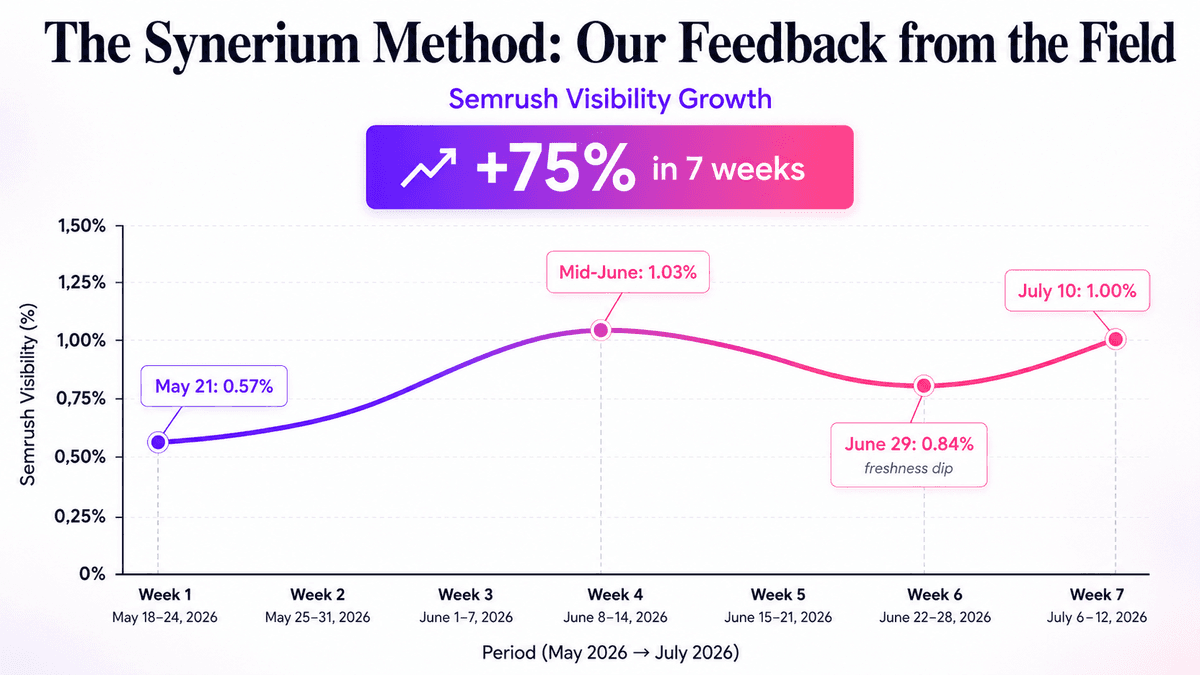
We don't like talking about ourselves in our articles. But on this precise subject, our field experience provides concrete proof that the method works. Here are the facts, sourced.
Starting point (May 21, 2026)
Semrush France visibility: 0.57%. Average position: 96.87. 554 tracked keywords. 4 keywords in the top 10. A domain in a classic priming phase, with an inherent penalty due to its newness.
What we implemented in 7 weeks
Publication of a pillar "ChatGPT vs Claude vs Lovable vs web agency" with concrete cases and quantified data: this is our comparative study on ChatGPT, Claude, Lovable or a web agency. In parallel, creation of three technical expertise pages (WordPress, WooCommerce, Next.js) with 5,000 words each, FAQs optimized for Schema.org, and strengthened E-E-A-T.
This content respects the GEO method: direct answers at the start of each section, proprietary data, complete markup, topical authority built in cluster.
The result on July 10, 2026
Semrush France visibility: 1.00%, up 75% compared to May 21. 629 tracked keywords. 10 keywords in the top 10, including 4 in position 1. Positioning on competitive keywords like "lovable vs agence web" (position 4), "chatgpt vs agence web" (position 28), "woocommerce sur mesure pme" (position 4).
It's not a miracle. It's the methodical application of an editorial strategy designed for the post-AI Overviews era. And it works.
The main lesson
SEO is not dead, it has densified. You need to produce less content, but much stronger. A 4,000-word pillar with proprietary data beats ten 800-word generic articles. A team that publishes every 10 to 14 days regularly beats a domain that spams then stops.
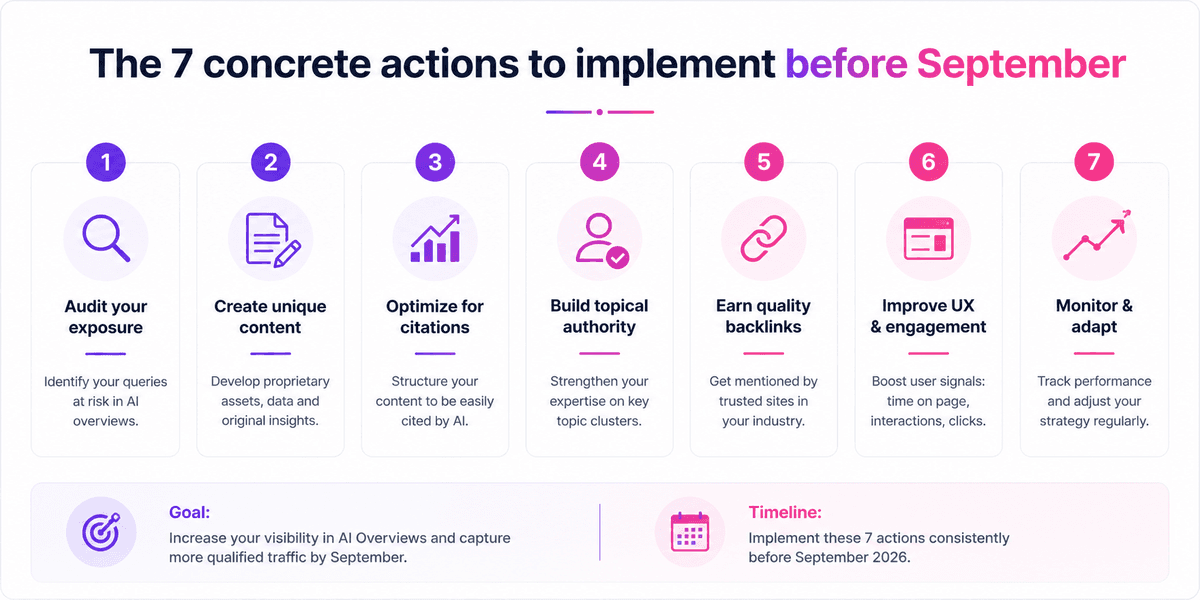
The 7 concrete actions to implement before September 2026
Let's move to execution. Here are the 7 priority actions to deploy on your site in the next 4 to 10 weeks.
Action 1: audit your most exposed pages
Identify in Google Search Console your 20 pages that generate the most traffic on generic informational queries ("what is", "how", "why"). These are your most threatened pages by the arrival of AI Overviews. Absolute priority: reinforce them.
Action 2: restructure your existing FAQs
Each FAQ section must be marked up Schema.org FAQPage, with a complete question and a direct answer in 60 to 120 words. Well-structured FAQs are paradoxically those that get cited as sources by AI Overviews.
Action 3: inject proprietary data wherever possible
Add to your existing articles exclusive figures, mini-studies, internal benchmarks. An article with "according to our analysis on 200 SMB clients in 2026, 68% encounter the X problem" will have infinitely more chances of being cited than a generic article.
Action 4: strengthen E-E-A-T with detailed author pages
Every substantive article must be signed by an identified author, with a detailed bio, demonstrated expertise, a LinkedIn link and, possibly, certifications. Create author pages if they don't exist. It's a heavy but critical investment to be cited by AI.
Action 5: deploy Schema.org on all your strategic pages
Article + Author + FAQPage + BreadcrumbList markup on your pillars. HowTo on your practical guides. Product + Review on your commercial pages. LocalBusiness on your local pages. Don't leave any page without structured data if it aims to rank.
Action 6: create 1 to 3 interactive tools for your market
ROI calculator, diagnostic quiz, simulator, configurator, generator. An interactive tool is the best defense against absorption by AI Overviews. Prioritize tools that respond to a real business need of your prospects.
Action 7: configure the new GSC AI Overviews report
Since June 2026, Google Search Console offers dedicated reports on performance in generative features. Activate them in your GSC, define your KPIs (AI impressions, average position in AI Overviews, citation rate), set up monthly monitoring.
The 5 mistakes that make everything worse, to absolutely avoid
Facing the general concern, many agencies and SMBs make counterproductive choices. Here are the most frequent mistakes.
Mistake 1: producing generic AI content without proof
Generating 100 articles with ChatGPT without enriching them with proprietary data is the worst possible choice in 2026. Google identifies these contents, considers them low quality, and penalizes them. Some sites have lost up to 60% of their traffic by rushing into this path.
Mistake 2: wanting to optimize everything at once
An SMB cannot rebuild 300 pages in 6 weeks. Start with the 20 pages that generate 80% of your traffic. Optimize them thoroughly. Then expand. The incremental method always beats the blocking large project.
Mistake 3: neglecting maintenance of existing content
An article from 2023 not updated loses its legitimacy in 2026. AI favors recently updated content. Take your 20 best articles, update the data, redate them. Immediate effect on your perceived authority.
Mistake 4: ignoring alternative answer engines
ChatGPT Search, Perplexity, Claude, Gemini are becoming significant acquisition channels for B2B SMBs. Visitors from these platforms have a higher conversion rate than those from classic Google, according to the GEO Valiuz Barometer (July 2026). Optimize for these engines too.
Mistake 5: stopping production to save money
This is perhaps the most insidious mistake. Facing uncertainty, many SMBs slow down their production pace. It's exactly the opposite that should be done. Google favors active domains. A regular publication pace, one pillar every 10 to 14 days, is your best defense.
Take action before it’s too late
The deployment of AI Overviews in France is confirmed for September 23, 2026 at the latest. You still have time to prepare your site, but every week that passes reduces your room for maneuver. SMBs that structure their content today will be those that appear in AI summaries from the day of deployment. Others will discover their traffic collapsed and try to repair urgently, in panic. To go deeper into our approach to the modern web, our web development expertise details our know-how.
At Synerium, we support French SMBs in this transition with a simple model: a monthly subscription covering all necessary SEO and GEO work, without quotes for each request, with a dedicated senior team. To explore our plans, discover Synerium Infinity; and to finance a structural redesign over 36 months with immediate ownership, there is Synerium Studio.
Main sources of this article: Ouest-France (June 29, 2026), Ahrefs (HubSpot analysis July 2026), Pew Research Center, BrightEdge, Indian School of Business and Carnegie Mellon, Semrush (July 2026), GEO Valiuz Barometer (July 2026), Google Search Console (AI reports since June 2026).