Why this article exists
Let us start with brutal honesty.
For nearly 20 years, we made web agency quotes. Probably more than a thousand. First as freelancers, then heading an agency. We know how these quotes are built, where the margins are, how the numbers get rounded, and most importantly what they never tell you.
Today Synerium is a subscription agency that specifically abandoned the quote model. So this article isn't neutral, and it's better to say it upfront. But it's factual, based on real day rates and margins from the French market in 2026, and it will give you concrete weapons to understand, compare and challenge the quotes you receive.
The reality is that most SME executives sign quotes without really understanding what they contain. They compare totals. €8,000 with one, €12,000 with another, €6,500 with the third. They pick the cheapest or the most reassuring. Six months later, they discover what they didn't see in the quote: unforeseen hours, optional features, extended deadlines, accumulated extras.
This guide gives you the reading grid no agency wants to share. Not to attack them, just to put you on equal footing when you negotiate.
What an agency quote doesn't tell you (but should)
A standard web agency quote fits on 2 to 4 pages. You'll generally find a project description, a breakdown into lots, estimates in man-days or in euros, payment terms, and a validity deadline.
What you'll almost never find:
● The real daily rate of each professional working on the project
● The agency's gross margin on the project (typically between 30 and 60 percent)
● The outsourced portion (to whom, in which country, at what day rate)
● The internal coordination hours billed but invisible
● The real cost of the salesperson who sold you the project
● The exact conditions for scope changes mid-project
● What happens if the agency falls behind on its side
● The cost of bugs discovered after delivery
All this information is essential to understand what you're really buying. Its absence isn't an oversight, it's a commercial choice: the less the client knows, the more margin of maneuver the agency keeps.
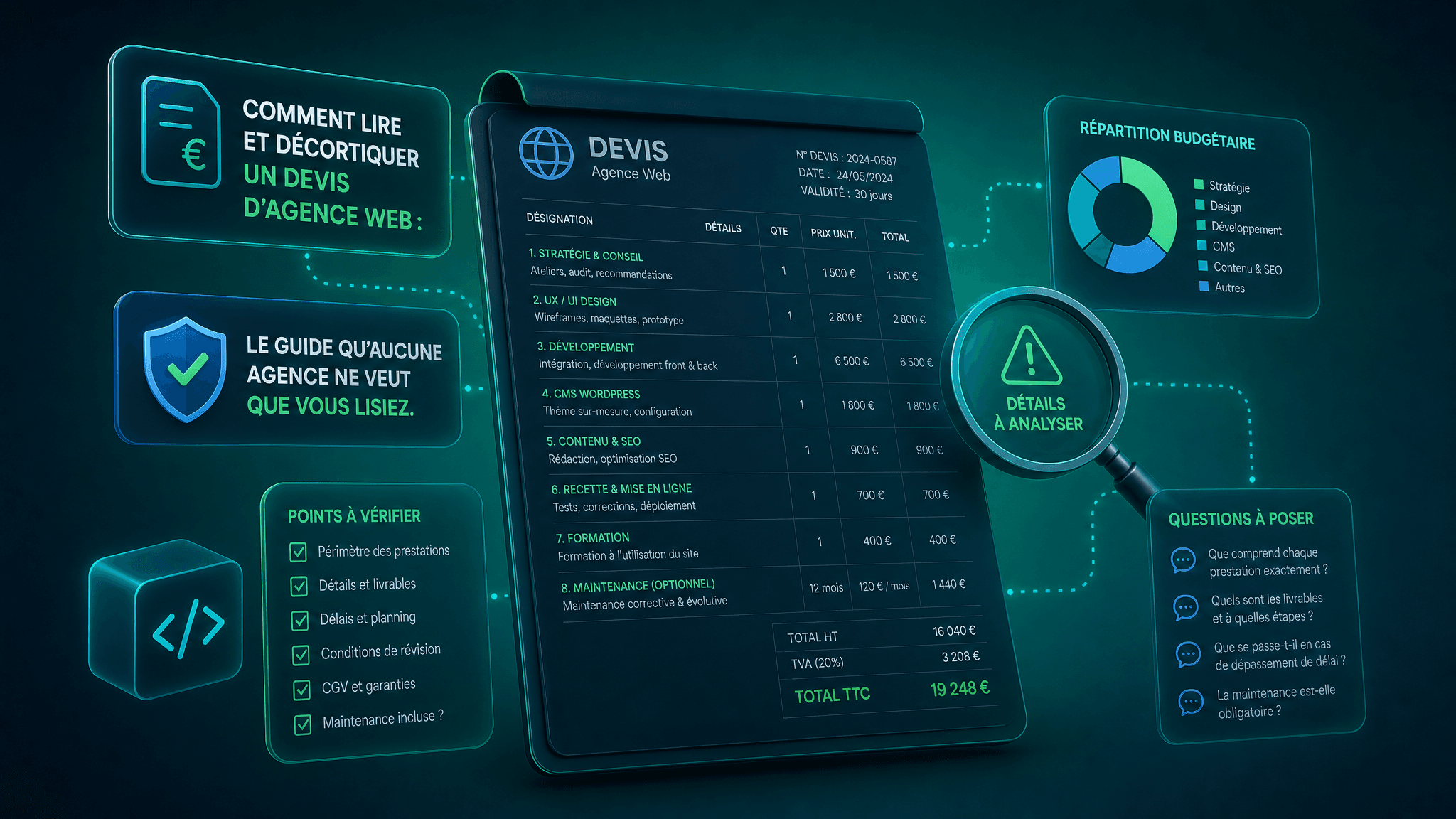
Anatomy of a web agency quote: the 8 standard lines decoded
Here's how a typical agency quote for a professional website breaks down. Let's take the example of an average showcase site, quote at €12,000 excluding tax, to make things concrete. Day rates mentioned correspond to 2026 French market benchmarks (sources: Malt, Free-Work, Hays France).
Reference: Real day rates in the French market in 2026
Before detailing each quote line, here are the daily rate ranges actually practiced in the French market in 2026, by profile and experience level. These figures come from the Malt 2026 barometer, Free-Work, Hays France 2026 and the Jobbers TJM 2026 study.
● Front-end developer: €350-450 junior, €500-600 confirmed, €700+ senior
● Back-end developer: €400-500 junior, €550-700 confirmed, €750-900 senior
● Full-stack developer: €400-500 junior, €550-650 confirmed, €700-900 senior
● UX/UI designer: €350-450 junior, €500-650 confirmed, €700-850 senior
● Digital project manager: €400-500 junior, €550-700 confirmed, €750-900 senior
● Web integrator: €250-350 junior, €400-500 confirmed, €550-650 senior
● Offshore contractor (Madagascar, Morocco, Romania, India): €100-150 junior, €150-200 confirmed, €200-280 senior
The average French freelance IT day rate in 2026 is €520/day across all IT sectors. Paris shows an average day rate of around €620/day vs €490-540/day for major regional metropolises. These geographic gaps are narrowing year by year with the generalization of remote work.
Line 1: Conception and UX (€1,500 to €2,500)
This line covers thinking about the sitemap, wireframes (functional black-and-white mockups), and content strategy. In reality, this step rarely consumes more than 3 to 5 days of actual work. At the average day rate of a confirmed UX designer in France (€500 to €650), we're looking at a real cost of €1,500 to €3,250. The agency's margin on this line is therefore generally low or nonexistent, because it serves as bait to sell the rest.
Line 2: Graphic design (€2,000 to €3,500)
Creation of graphic mockups for all key pages. The line where agencies make one of their best margins. A salaried web designer costs an agency about €350 to €450 per loaded day. Billed between €600 and €900 per day. The margin is therefore about 50 to 70 percent. Question to ask: how many graphic variations are included, and what does an additional iteration cost?
Line 3: Development (€4,000 to €7,000)
The big line. Often 50 to 60 percent of the total quote. The real cost for the agency varies enormously depending on who codes. A senior salaried dev in France costs an agency about €500 to €700 per loaded day. A junior dev €300 to €400. If the project is outsourced abroad (Madagascar, Morocco, Romania, India), the cost drops to €100 to €250 per day. The agency margin on this line can reach 70 percent when there's outsourcing and the client isn't aware.
Line 4: Content integration (€500 to €1,500)
Entering your texts, setting up images, configuring forms. This line is often largely overestimated. In reality, integrating 10 to 15 content pages rarely takes more than 1 to 2 days for an experienced integrator (day rate €400-500). If it's billed at €1,500, that's €750 to €1,000 per billed day for this level of task, which has high margin.
Line 5: Tests and approval (€500 to €1,000)
Validation phase before going live. Frequently underestimated in the quote, which means bugs discovered after going live often fall into a contractual gray zone. Question to ask: how many back-and-forths are planned, and what happens beyond?
Line 6: Going live and technical setup (€300 to €800)
Hosting, SSL certificate, DNS configuration, production deployment. This line covers operations that actually take less than half a day for a competent technician. It's typically a line where agencies apply a minimum flat rate to make a short but necessary technical operation profitable.
Line 7: Training and documentation (€300 to €800)
Training on backoffice use (for example WordPress, PrestaShop). This line is almost always flat-rate when it actually takes 2 to 4 hours of video call. Often done by a project manager at €600 per day, so real cost around €150 to €300 for the agency. Typical margin of 100 percent.
Line 8: Project management (10 to 20 percent of total)
Internal coordination, client follow-up, meetings. This line is almost always invisible or hidden in other lines. Yet it represents 10 to 20 percent of the total quote. On a €12,000 project, that's €1,200 to €2,400 going to internal coordination. This line brings no direct value to your site, but it's unavoidable in the classic agency model.
The man-day trap: what it really hides
Most agency quotes are presented in man-days. It's reassuring: you feel like you understand. Twenty days of dev at €700 makes €14,000, it's clear.
Except it's not clear at all. Here's what the term man-day really hides.
First question: is it an effective man-day (7 hours of focused work on your project) or an administrative man-day (which includes internal meetings, breaks, coordination, so actually 4 to 5 hours of real production)? The difference changes everything. On 20 announced man-days, you actually receive the equivalent of 12 to 15 days of effective production.
Second question: is it the billed rate or the real cost for the agency? When you're told €700 per day, that's what you pay. But what the agency pays to have this developer is between €300 and €500 if it's a French employee, and between €100 and €250 if it's an outsourced contractor abroad.
Third question: is the announced number of man-days an honest estimate or an inflated estimate to absorb the unforeseen? Experienced agencies know that a web project almost always exceeds its initial estimate by 20 to 40 percent. The most common practice: a buffer of 20 to 30 percent integrated from the start, as confirmed by La Fabrique du Net in its 2026 barometer.
The 4 hidden margins every agency applies (and it's normal)
This paragraph will sound accusatory, but it isn't. An agency is a business, it has to make a living. The problem isn't that there are margins, the problem is that they're not visible.
Margin 1: Gross production margin
The agency bills man-days more than it pays its producers. That's normal. Generally, the ratio is 1 to 3 between the producer's cost and the billed price. On a €12,000 project, the real production cost is rather between €4,000 and €6,000. The rest finances the agency's fixed costs and profit.
Margin 2: Margin on outsourcing
If part of the project is outsourced abroad or to freelancers, the agency applies a margin on it. Typically between 30 and 100 percent. You pay €700 per day, the outsourcer receives €150 to €350. The difference is pure margin. Important question to ask: is your project outsourced? To whom? How much do they receive per day?
Margin 3: Margin on unused options
Many quotes include options that will never be used. For example: 5 design iterations when most clients ask for 2. Or 3 days of testing when the project is delivered clean in 1 day. This invisible margin benefits the agency without the client being able to quantify it.
Margin 4: Margin on deadlines
Agencies almost always integrate a buffer in their announced deadlines. If they announce 8 weeks, they know they can deliver in 5 to 6 if everything goes well. The difference (the 2 to 3 weeks of buffer) is generally used to absorb the unforeseen, but it can also be sold elsewhere if the project moves quickly. It's a perfectly legitimate capacity optimization, but it means your deadlines can be shortened if you challenge them.
The 5 lines you should ALWAYS challenge
Here are the 5 systematic lines of a quote you can (and should) negotiate. Not out of stinginess, but because these are zones of imprecision that can represent 20 to 30 percent of a quote.
Line 1: The number of design iterations
Every quote should specify how many graphic variations are included, and what an additional iteration costs. If it's not specified, ask. Standard practice is 2 or 3 iterations before final validation. If the agency offers you 5 or 6, it's overestimated.
Line 2: Project coordination
Ask precisely how many project manager hours are planned, and how many hours you'll actually see this project manager. If coordination represents 15 to 20 percent of the quote (which is frequent), challenge it. A well-organized project doesn't require more than 10 percent of internal coordination billable to the client.
Line 3: Tests and approvals
How many validation phases are planned? How many back-and-forths are included? What happens for bugs discovered after going live? This line is almost always minimized in the quote to not scare the client. Result: post-delivery bugs are almost always billed extra.
Line 4: Maintenance and support
After delivery, who maintains your site? How much does it cost? If the quote doesn't mention this question, it's intentional. Once the site is delivered, the agency will offer you a maintenance contract that can cost €100 to €500 per month. Negotiate it from the initial quote, not after. Our complete guide on WordPress maintenance details the real orders of magnitude on this cost item often underestimated in initial quotes.
Line 5: Code and access ownership
Who owns your site's source code? Will you have all administrator access? Will you be able to change agency without difficulty? These questions are almost never addressed in the quote. Yet their absence can tie you for years to an agency you no longer want.
Calculating the real day rate (and why it's rarely what they tell you)
On a €12,000 quote for a showcase site delivered in 8 weeks, here's the calculation you should do.
The agency will tell you it spent about 20 to 25 days on the project. So an apparent day rate of €480 to €600 per day. That seems reasonable and consistent with the 2026 average freelance IT day rate (€520/day according to Malt).
The reality: on these 20 to 25 announced days, the actual production time (real creation and code) represents about 10 to 15 days. The rest (5 to 10 days) is coordination, meetings, administrative tasks, sales. So the real production day rate turns out to be around €800 to €1,000 per day, or even more.
And that's without counting that these 10 to 15 production days are often split between several people (designer, front dev, back dev, integrator), each billing their days, which multiplies the margins.
Concrete example: breakdown of a €12,000 quote
To make the calculation transparent, here's the real breakdown of a typical €12,000 quote for a showcase site. The first number is what's billed to the client, the second is what each line actually costs the agency.
● Conception and UX (5 days): client bill €2,000, real agency cost around €2,250. Low or even negative margin on this loss-leader line.
● Graphic design (5 days): client bill €2,500, real agency cost around €1,250. Gross margin around 50 percent.
● Development (10 days): client bill €5,500, real agency cost around €3,000 if French producer, or around €1,200 if offshore outsourcing. Variable margin of 45 to 78 percent depending on production mode.
● Content integration (2 days): client bill €1,200, real agency cost around €700. Gross margin around 42 percent.
● Tests and going live: client bill €800, real agency cost around €400. Gross margin around 50 percent.
Total: the client pays €12,000. The agency spends between €5,800 (with significant offshore outsourcing) and €7,600 (with 100 percent French production). Its gross margin is therefore between €4,400 (37 percent) and €6,200 (52 percent), before financing its fixed costs and net profit.
These figures are theoretical and vary depending on each agency's structure. But the order of magnitude is right: on a €12,000 quote, count about 35 to 55 percent of gross margin for the agency.
The method to estimate the real rate of a quote: take the total of the quote, divide by the number of announced man-days, and multiply by 1.5 to 2 to get the real production day rate. If the resulting figure seems inconsistent with the level of service, you've identified a problem.
Comparing 3 quotes: the method to separate apples from oranges
When you receive 3 quotes for the same project, you almost always get 3 different totals: €8,000, €12,000 and €18,000 for example. Why this gap, and which one to choose?
First step: make a line-by-line comparison table. Not by totals, by lines. Put the 8 standard lines (conception, design, dev, integration, tests, going live, training, project management) in columns, and the 3 agencies in rows. You'll discover that gaps are never uniform: an agency can be 30 percent cheaper on design and 50 percent more expensive on dev. That's where you start to understand the trade-offs.
Second step: verify what's included and what's not. An agency at €8,000 may not include testing, training, basic SEO or maintenance. An agency at €18,000 may include everything plus 6 months of free support. These aren't the same quotes, even if they appear comparable.
Third step: ask each agency the same questions. How many man-days? What real day rate? What share of outsourcing? What margin on iterations? The answer to these questions often reveals more than the total itself.
The 7 questions to ask BEFORE accepting a quote
Here are the 7 questions you should systematically ask before signing a quote. No serious agency will refuse to answer. If it refuses, that's already an answer.
Question 1: Who exactly codes, designs and coordinates my project?
You have the right to know who will work on your project. Internal employees, freelancers, foreign subcontractors? This information changes everything about final quality and possible communication.
Question 2: What is the billed day rate per profile?
Designer, front developer, back developer, project manager. Ask for detailed rates. An honest agency will give them to you. An agency that refuses has something to hide.
Question 3: What happens if you exceed the planned time?
Standard answer: it's on your side, so billed extra. That's unacceptable. Negotiate: if the agency exceeds its initial estimate by more than 10 percent, the excess is on its side.
Question 4: How many iterations are included on each step?
Conception, design, dev, tests. Be specific. Standard practice is 2 to 3 iterations per step. Beyond that, it's billed extra.
Question 5: Who owns the code and the designs?
You must be the full owner of everything you pay for. Code, designs, content, configurations. This clause must be explicit in the contract.
Question 6: What exactly does post-delivery maintenance include?
How many free bugs? For how long? What do you pay after? This question avoids the bad surprise of the expensive maintenance contract offered 3 months after delivery.
Question 7: What is NOT in the quote?
Trick question but essential. Explicitly ask what the agency hasn't included in its quote and that will be necessary for the project. Hosting? Domain name? GDPR compliance? Cookie policy? SEO? Often these elements are optional and add €1,500 to €3,000 invisible to the initial quote.
The free quote trap and what it really hides
All quotes are free, it's the market norm. But the reality is that the commercial phase preceding the quote costs the agency between 1 and 5 hours of work per prospect. Multiply by the number of prospects who will never sign, and you understand that this commercial phase has a real cost.
This cost is invisibly passed on to the clients who sign. It's mathematical: on 10 quotes sent, an agency signs an average of 2 to 4. The commercial cost of the 6 to 8 lost quotes is integrated into the price of the 2 to 4 won projects. Concretely, on a €12,000 quote, you probably pay €500 to €1,500 of commercial cost for the prospects who said no before you.
It's one of the paradoxes of the classic agency model: the more an agency has rejecting prospects, the more its real clients pay. An agency in a subscription model doesn't have this recurring commercial cost, because its clients are committed long-term and it doesn't have to redo a quote for each request.
The alternative: what if you just stopped doing quotes?
After reading all the above, an obvious question arises: if quotes are this opaque and friction-generating, why do we keep using them?
The answer is cultural more than rational. The quote has been the industry norm for 30 years, everyone does it this way, so no one questions the system. But other models exist.
The digital subscription model, for example, which we detail in our complete guide on the unlimited web agency, replaces ad-hoc quotes with a fixed monthly fee. You pay the same amount each month. In return, the agency delivers all design, dev and marketing requests that fit within the scope. No quote to modify a page. No estimate to add a feature. No negotiation for every request.
This model has a major advantage: it aligns the interests of the agency and the client. In the classic quote model, the agency earns more when the client asks for more billable services. In the subscription model, the agency earns more when it's efficient and keeps the client satisfied over time.
That's exactly what we've built with Synerium. Our Infinity offer provides 3 all-inclusive digital subscription packages starting at €742 per month. For companies that prefer to spread the cost of a new creation, our Studio offer provides a custom site financed over 36 months.
It's not the only alternative model to the quote. But it's the one that best aligns interests, and that allows SMEs to plan their digital budget without surprise.
Frequently asked questions about web agency quotes
Is it legitimate to ask an agency for its gross margin on the project?
Legitimate yes, but few agencies agree to communicate it directly. You can bypass by asking the billed day rate per profile and the number of man-days per profile. With these two pieces of information, you can estimate the production cost and therefore the approximate margin.
How many design iterations am I normally entitled to?
Standard practice is 2 to 3 iterations before final validation. Any additional iteration is generally billed between €200 and €500 depending on the agency. This information should be in the quote. If it isn't, ask for it explicitly.
What to do if the agency exceeds its initial estimate?
In 80 percent of cases, the excess is billed to the client. It's unfair. The right reflex is to negotiate from the initial quote a ceiling clause: any excess of more than 10 percent over the estimate is on the agency, except for explicit scope change.
Should I prefer a fixed-price quote or a time-and-materials quote?
Fixed-price for a well-defined project with a clear scope. Time-and-materials (payment per hour or per day) for an evolving project with uncertainties. The majority of SME websites are actually better suited to a subscription model that combines the advantages of both: fixed rate and continuous flexibility.
How long should we take to evaluate a quote?
At least a week. The classic trap is to sign in urgency after a commercial meeting. Once the quote is received, take the time to analyze it line by line, ask your questions in writing, and compare with at least 2 other quotes.
What to do if I discover hidden costs after signing?
Immediately ask in writing for the contractual basis of the additional costs. If the agency can't show you where this line was planned, you can refuse to pay the surcharge and demand a valid amendment. Most agency/client disputes come from this gray zone. Better to clarify from the start.
Is the cheapest always the worst?
No. A quote 30 percent cheaper can be serious if the agency has a different structure (fewer project managers, fewer Paris offices, more remote work, well-organized outsourcing). The real subject isn't the price but what's included and what isn't.
How to know if an agency outsources?
Ask the question directly. An honest agency will answer. Otherwise, ask to meet via video call the profiles who will work on your project, and observe the accents, the time zones of email responses, the signatures of the participants. Outsourcing isn't a problem in itself (quality can be excellent), but it must be transparent.
Conclusion: Knowledge is the power to negotiate
No one needs to feel naive for having signed quotes without understanding everything. The entire agency industry system is built so clients don't ask too many questions. The simple fact of having read this article puts you in a position of strength that very few executives reach.
Next time an agency presents you with a quote, pull out the 7 questions, make the comparative table of lines, ask for the day rates per profile. You'll immediately feel the difference between an agency playing with its cards on the table and an agency hiding its hand. This simple test clarifies a lot of things.
And if after all this, you tell yourself that this ad-hoc quote system is no longer for you, you can discover how we work at Synerium, with a model that simply eliminates the quote and replaces it with a fixed monthly subscription. Whatever your choice, you'll now be equipped to decide knowingly.
