
56% of French SMBs have a website. Second-to-last in Europe. Yet they're the continent's most optimistic about artificial intelligence. How to explain this paradox? What the Ionos, Bpifrance and France Num 2026 studies really reveal, and what it means for your SMB in the coming months.
The real state of French SMB digital in 2026 (the numbers that hurt)
Let's start with facts. Not opinions, not intuitions. Verifiable figures from serious studies published between January and July 2026. What we're about to discover isn't comfortable. It's necessary.
Last place in Europe for professional email
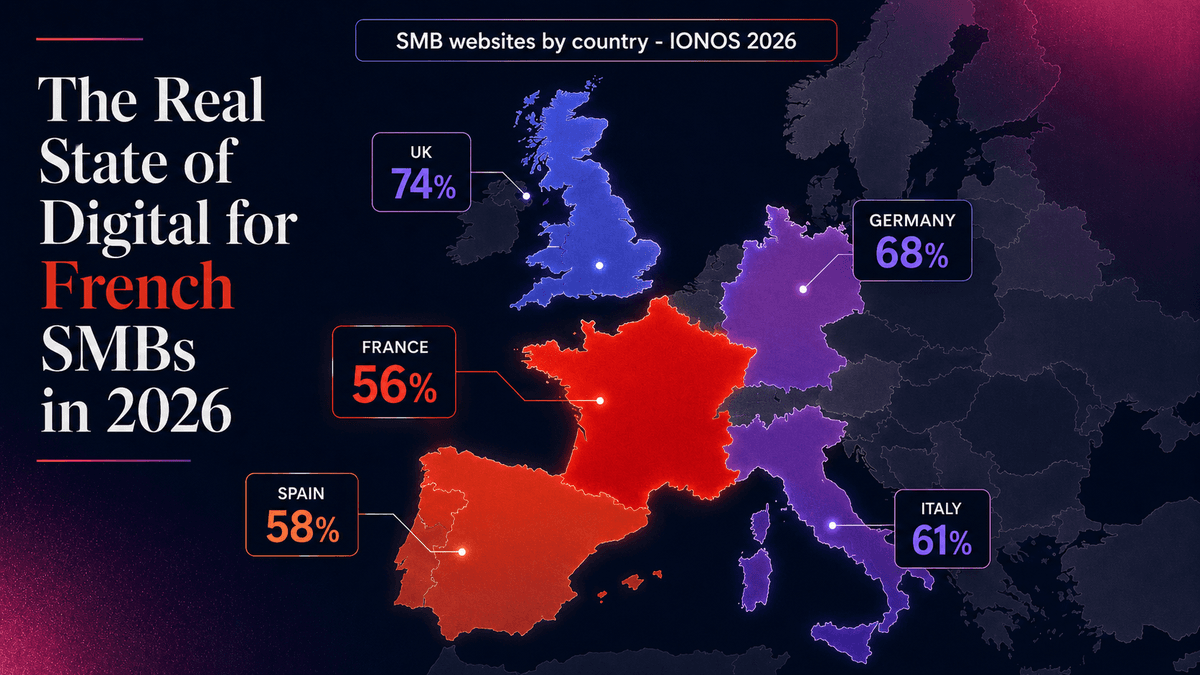
According to the annual Ionos/YouGov 2026 study, conducted with 4,000 European SMB decision-makers including 506 in France between January and March 2026, only 54% of French SMBs have a professional email with their own domain name. Last place in Europe, far behind Germany (67%), the UK (72%), Italy (61%), and Spain (58%).
To be clear: nearly one French SMB out of two still communicates with clients from a Gmail, Hotmail, or Orange address. For a leader in 2026, this is no longer a preference, it's a professionalism signal your prospects read unconsciously.
Second-to-last for website ownership
56% of French SMBs have a website. Second-to-last position in Europe. The European average is 65%. In Germany, it reaches 68%. In the UK, 74%.
This figure is particularly striking in 2026, when 76% of French leaders surveyed acknowledge that digitalization has a direct impact on their revenue. In other words: a significant portion of leaders understand the stakes, but haven't yet taken the first step.
4th place for online productivity tools
45% of French SMBs use online productivity tools, versus a European average of 51%. Google Workspace, Microsoft 365, Notion, Airtable remain minority. Most SMBs continue to work with Word and Excel files on local computers, with the collaboration and security problems this implies.
The global European ranking
Among the 28 European countries measured by the DESI index (Digital Economy and Society Index), France ranks 16th in general digitalization. According to McKinsey, France's digital GDP represents 5.5%, versus 10.1% in South Korea, 10% in the UK, 9.2% in China, and 8% in the US. France exploits only 12% of its digital potential, when the US exploits 18% and the UK 17%.
These figures aren't a critique. They're a state of affairs. And a starting point.
The great paradox: France is Europe's most enthusiastic about AI
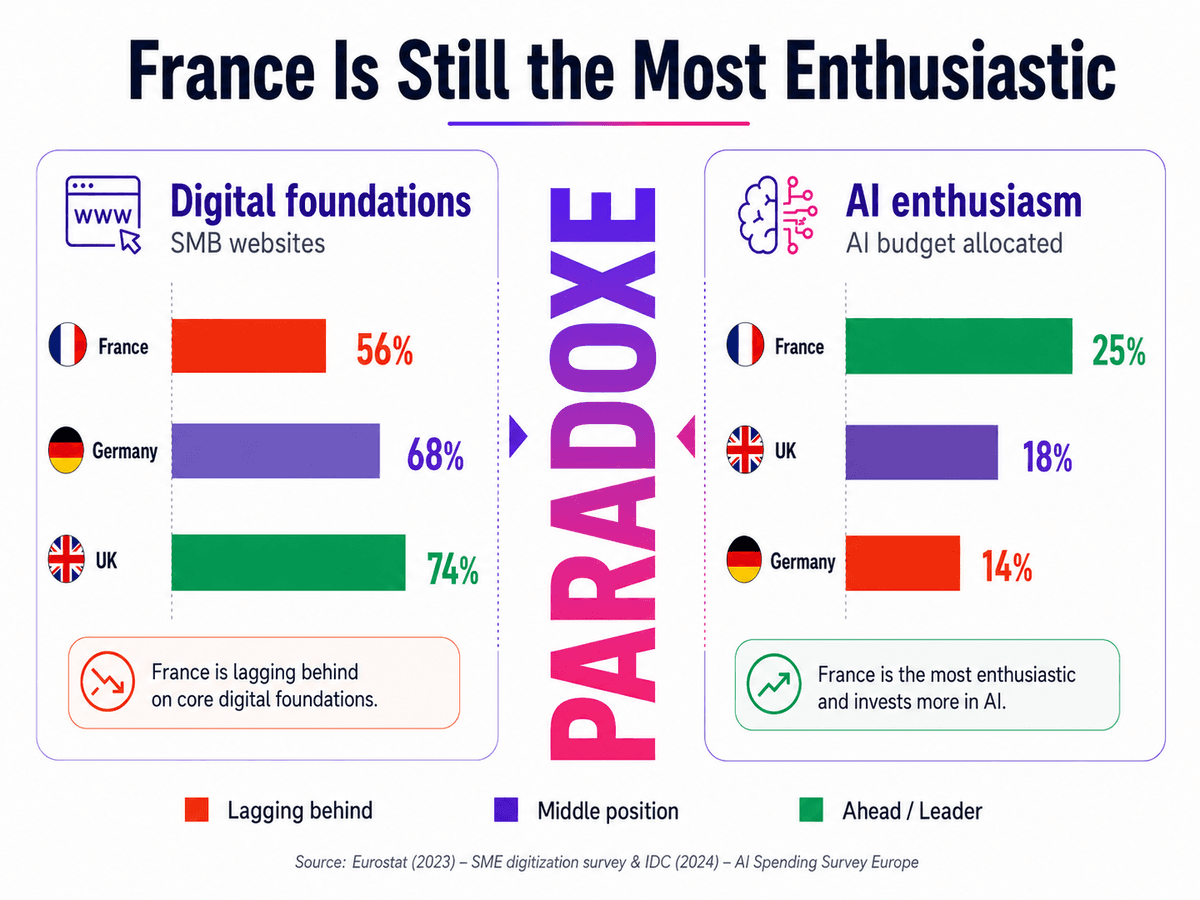
Here's where the Ionos 2026 study becomes really interesting. While French SMBs lag clearly on digital fundamentals, they're Europe's most enthusiastic about artificial intelligence. A paradox worth examining. And this AI race also means preparing for new SEO challenges, like AI Overviews arriving in France before September 23, 2026.
The least skeptical of AI in Europe
Only 11% of French SMB leaders say they're skeptical of AI, versus a European average of 17%. The lowest rate of the five countries studied (Germany, France, UK, Italy, Spain).
The highest AI budgets in Europe
25% of French SMBs plan to allocate between 11% and 20% of their digital budget to AI projects. That's the highest share in Europe. And 11% plan to devote between 21% and 50% of their budget to AI, versus only 6% average across the five countries.
In other words, when a French leader decides to invest in digital, they put a larger share on AI than their European counterparts. Not on their website. Not on their pro email. On AI.
AI seen as a major competitive advantage
24% of French SMBs see AI as having the greatest potential to gain a competitive advantage over rivals, versus a European average of 19%. Five points of difference. Significant.
The quote that sums it all up
Achim Weiss, CEO of Ionos, summed up the paradox in one sentence worth pondering: "You don't build a skyscraper on foundations of sand."
The idea is simple. AI needs a "digital home" to be effective. An SMB without a website, without professional email, without online collaboration tools cannot leverage AI in its client interactions or internal processes. It can buy ChatGPT subscriptions, it cannot build real competitive advantage.
Why does this paradox exist?
Our read, from the field with our Synerium clients: the AI buzz has created a hype effect pushing leaders to invest in the new before consolidating the basics. It's a major strategic error, but understandable. AI is spectacular. An email with a domain name isn't.
The problem is that without foundations, AI doesn't work. An AI chatbot plugged into an 800-euro website from 2019 doesn't convert. Prospecting AI without a CRM only sends generic messages. AI amplifies what already exists. If what already exists is shaky, AI amplifies the shakiness.
The 4 real reasons for French digital lag
Understanding the barriers is the first step to lifting them. The Ionos study clearly identifies the obstacles cited by French leaders themselves.
Barrier #1: lack of know-how (46%)
46% of French SMBs cite lack of know-how as a major barrier to digitalization. That's the highest rate in Europe, more than 6 points above the European average (40%).
Concretely: leaders know they need to digitalize, but don't know where to start, which tools to choose, how to prioritize, how to measure ROI. They lack a clear methodological framework.
Barrier #2: security concerns (48%)
48% of French SMBs cite data security and privacy as a major barrier, versus 43% average in Europe. Here again, France leads for these concerns.
Cyberattacks against SMBs exploded in 2024-2025 (ANSSI recorded 4,386 in 2024, +37% vs 2023). The media coverage of these attacks has created legitimate caution, but sometimes turns into paralysis.
Barrier #3: budget constraints
According to the Ionos 2026 study, 56% of French SMBs cite cost as the main obstacle to digitalization. This figure has been stable for several years, even as SaaS tool prices have dropped and public aid exists.
The real issue isn't so much the absolute cost as the perception of ROI. An SMB hesitates to invest 15,000 euros in a website, but can spend as much on printed catalogs or radio ads without questioning it.
Barrier #4: cultural inertia
This barrier isn't explicitly measured in studies, but our field experience confirms it. Many French SMB leaders grew up professionally at a time when digital wasn't central. Reconsidering their work habits, sales channels, client relationships requires considerable energy.
It's not a judgment. It's an observation. And it's also why external support can make the difference: it brings the fresh perspective internal organization can no longer produce.
The 4 digital maturity levels (which one are you?)
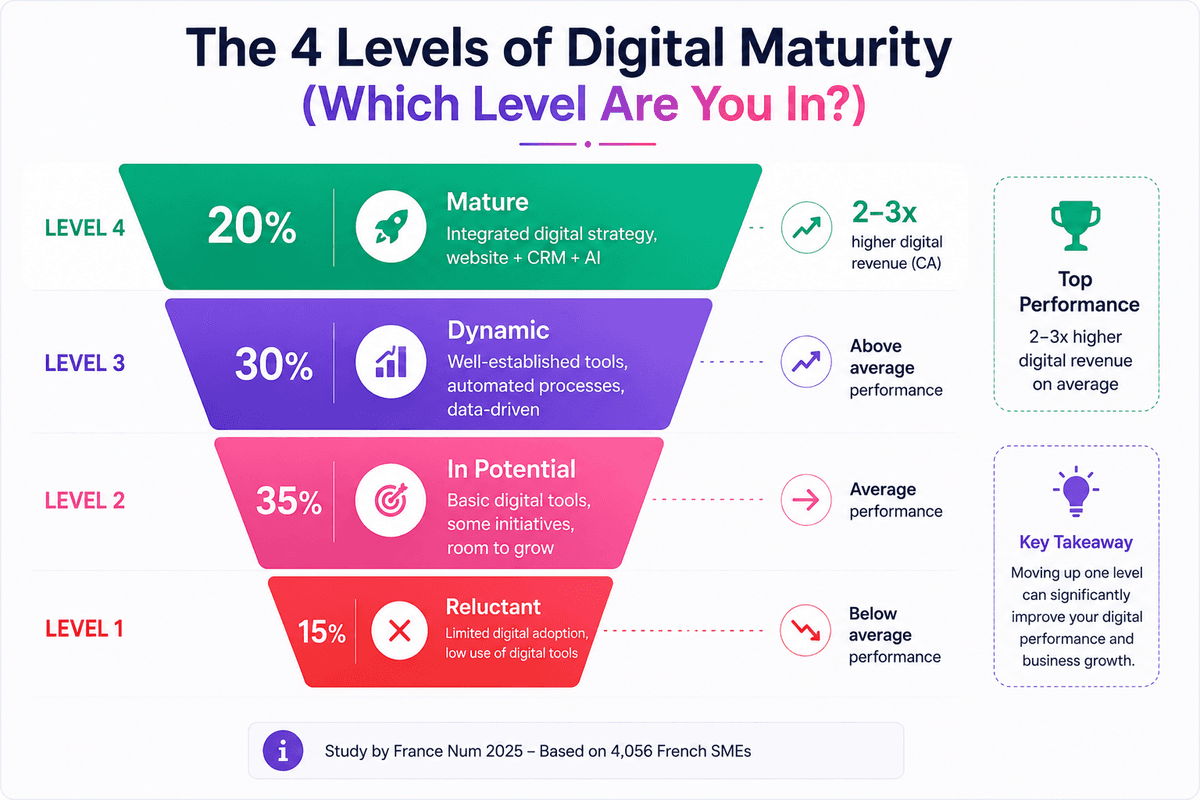
The France Num 2025 barometer classifies French SMBs into 4 digital maturity levels. Understanding where you are is essential to know what to do next.
Level 1: Mature SMBs (20%)
These SMBs have a high-performing website, use collaborative tools, have set up marketing automation, exploit their client data, and are beginning to integrate AI in targeted ways. Their digital revenue is 2 to 3 times higher than Reluctant SMBs.
Typical signs: Lighthouse > 90, conversion rate > 3%, CRM used daily, marketing automation in place, data-driven decisions.
Level 2: Dynamic SMBs (30%)
These SMBs have moved beyond the fundamentals. They have a modern website, active social media presence, a used CRM, and some digital marketing. They still lack advanced data exploitation and large-scale automation.
Typical signs: website redone less than 3 years ago, active LinkedIn or Instagram presence, occasional Google Ads or Meta Ads campaigns, loyalty emails.
Level 3: Potential SMBs (35%)
This is the largest category. These SMBs have the basics (website, pro email), but their tools are underused or outdated. They do digital in a passive way, not strategic.
Typical signs: website 4 to 8 years old, inactive Facebook page, no CRM or unused CRM, irregular digital communication.
Level 4: Reluctant SMBs (15%)
These SMBs are largely on the margins of digital. No website or obsolete website, personal email, client communication by phone and mail. They're often in traditional sectors where word-of-mouth long sufficed.
The problem: their digitalized competitors are progressively capturing their client base. The digital revenue gap widens by 15 to 20% per year.
The historic 2026 catch-up (real Bpifrance numbers)
Good news: France is massively catching up. The Bpifrance/OpinionWay 2026 study, published late December 2025 among 2,500 SMB leaders (10 to 250 employees), reveals figures that make heads spin.
82% of SMBs invest in digital
82% of French SMBs plan to invest significantly in their digital transformation in 2026, or +35 points from 2024. This progression is Europe's fastest over this period.
It's no longer progressive adoption. It's massive, coordinated acceleration.
Average budget: 75,000 euros per company
The average budget allocated to digital transformation per SMB reaches 75,000 euros in 2026, or +120% from 2024. This budget explosion is explained by a realization: digital is no longer optional.
15.8 billion euros in total investments
Across all French SMBs, 15.8 billion euros will be invested in digital transformation in 2026. It's a national-scale movement.
+3.2% projected growth
According to INSEE projections integrated into the study, this wave of digital investment should generate +3.2% additional growth for French SMBs in 2026-2027.
The real cost of inaction for your SMB (concrete calculation)
The real figure to remember isn't what digital costs. It's what inaction costs. And to go deeper on pricing, learn how to decipher a web agency quote before you commit. Let's calculate for a typical SMB.
The case of an SMB with 500,000 euros annual revenue
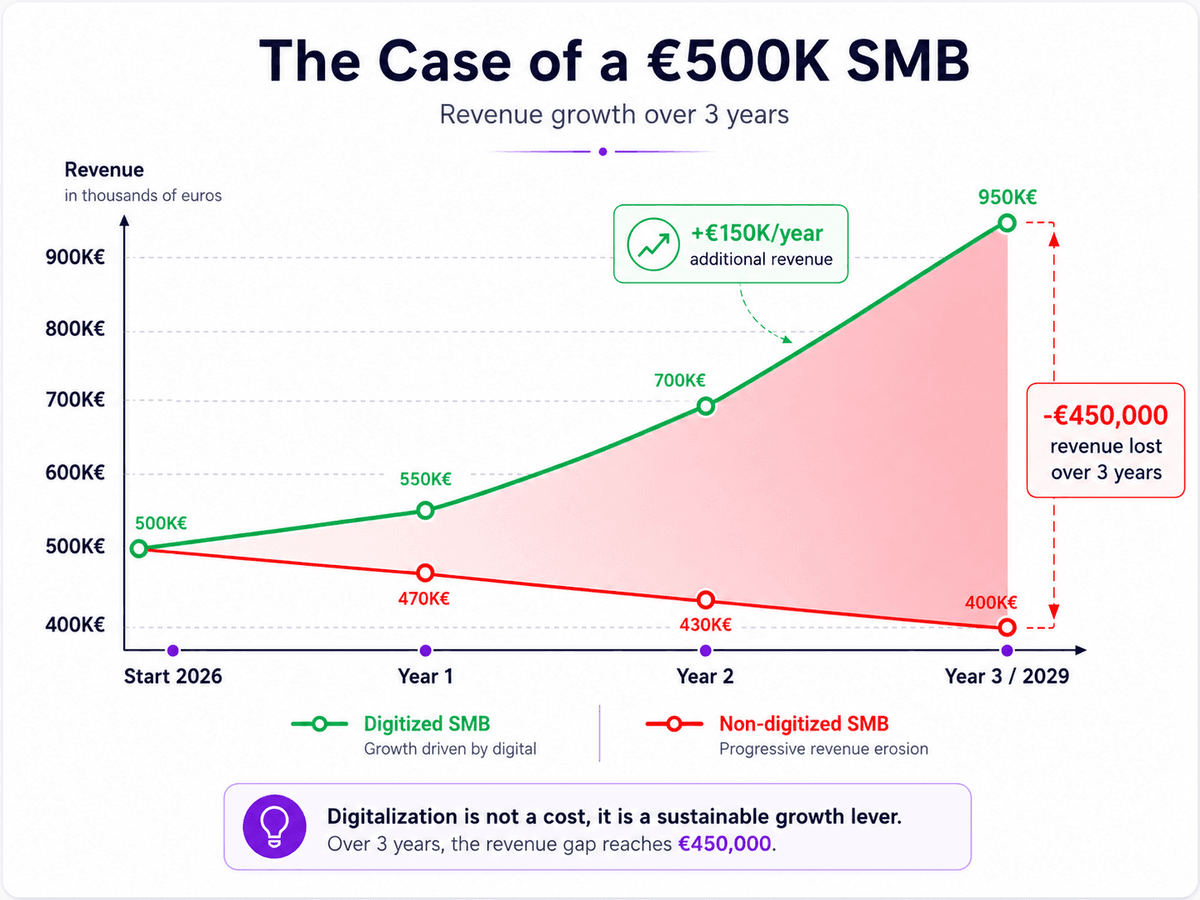
Let's take a B2B services SMB with 500,000 euros annual revenue, 5 employees, no high-performing website, no CRM, no social media presence.
Calculating potential loss:
According to Bpifrance, 26% of French SMBs generate more than 30% of their revenue via the web
A non-visible SMB potentially misses out on 150,000 euros of annual revenue (30% of 500,000)
Over 3 years, that's 450,000 euros of lost revenue
Calculating digitalization cost:
A modern professional website: 15,000 to 25,000 euros (amortized over 5 years = 4,000 to 5,000 euros/year)
A CRM: 300 to 800 euros per month (3,600 to 9,600 euros/year)
Digital marketing: 12,000 to 24,000 euros/year
Total average digital investment: about 25,000 euros per year
The ratio is edifying:
Digitalization cost over 3 years: 75,000 euros
Revenue lost without digitalization over 3 years: 450,000 euros
Profitability ratio: 1 to 6
Where to start your digitalization (Synerium 3-phase method)
Now that the observation is made, let's move to action. The Synerium method rests on simple logic: build in the right order. Too many SMBs skip steps and end up with tools that don't talk to each other. This is the opposite of the classic agency model and its one-off projects.
Phase 1: Foundations (3 to 6 months)
The objective: have a professional digital presence that inspires trust.
The 4 essential building blocks:
- A modern website (Lighthouse performance > 85, mobile-first, basic SEO): 12,000 to 25,000 euros for a classic SMB
- A professional email with your domain name: 5 to 15 euros/month per user
- An optimized Google Business Profile: free but critical for local SEO
- Online productivity tools (Google Workspace or Microsoft 365): 6 to 12 euros/month per user
Mistake to avoid: investing in AI before having these 4 blocks. You'll build on emptiness.
Phase 2: Automation (6 to 12 months after Phase 1)
The objective: save time on repetitive tasks and improve client relationships.
The 4 blocks to add:
- A CRM used daily (HubSpot, Pipedrive, or French solution like Sellsy): 30 to 100 euros/month per user
- A marketing automation tool (Brevo, ActiveCampaign): 30 to 200 euros/month depending on base
- A project management tool (Notion, Asana, Monday): 8 to 20 euros/month per user
- Online invoicing connected to your accounting (Pennylane, Qonto): free to 40 euros/month
Mistake to avoid: buying tools without training teams.
Phase 3: Intelligence (12 to 24 months after Phase 2)
The objective: exploit your data and integrate AI in targeted ways for measurable gains.
The 4 final blocks:
- A data dashboard (Metabase, Looker Studio): free to a few hundred euros
- A generative AI connected to your knowledge base (client chatbot, sales assistant): 200 to 2,000 euros/month
- Predictive analysis (churn, up-sell, cross-sell): depending on data maturity
- Advanced inter-tool automation (Zapier, Make, n8n): 20 to 200 euros/month
Mistake to avoid: skipping Phases 1 and 2 to jump directly here. This is precisely what France does according to the Ionos 2026 study, and what explains the paradox.
Conclusion: exiting the paradox, choosing your trajectory
The French digital paradox is real, documented, measured. French SMBs are last in Europe for digital foundations, but first for AI enthusiasm. This configuration isn't viable in the medium term.
The good news is that France is catching up massively: 82% of SMBs invest in 2026, with an average budget of 75,000 euros, up 120% from 2024. The train is moving.
At Synerium, we work with SMBs at all stages. No judgment on the starting point. Just a clear method to build in the right order, with predictable budget: our unlimited agency model in a monthly subscription without quotes for each request.
To explore our packages, visit Synerium Infinity. To finance a first site over 36 months with immediate ownership, discover Synerium Studio.
And to go deeper on modern web development, see our web development expertise.
Main sources: Ionos/YouGov (2026 study on 506 French SMBs), Bpifrance/OpinionWay (2026 study on 2,500 SMB leaders), France Num (2025 barometer), McKinsey, INSEE, ANSSI.