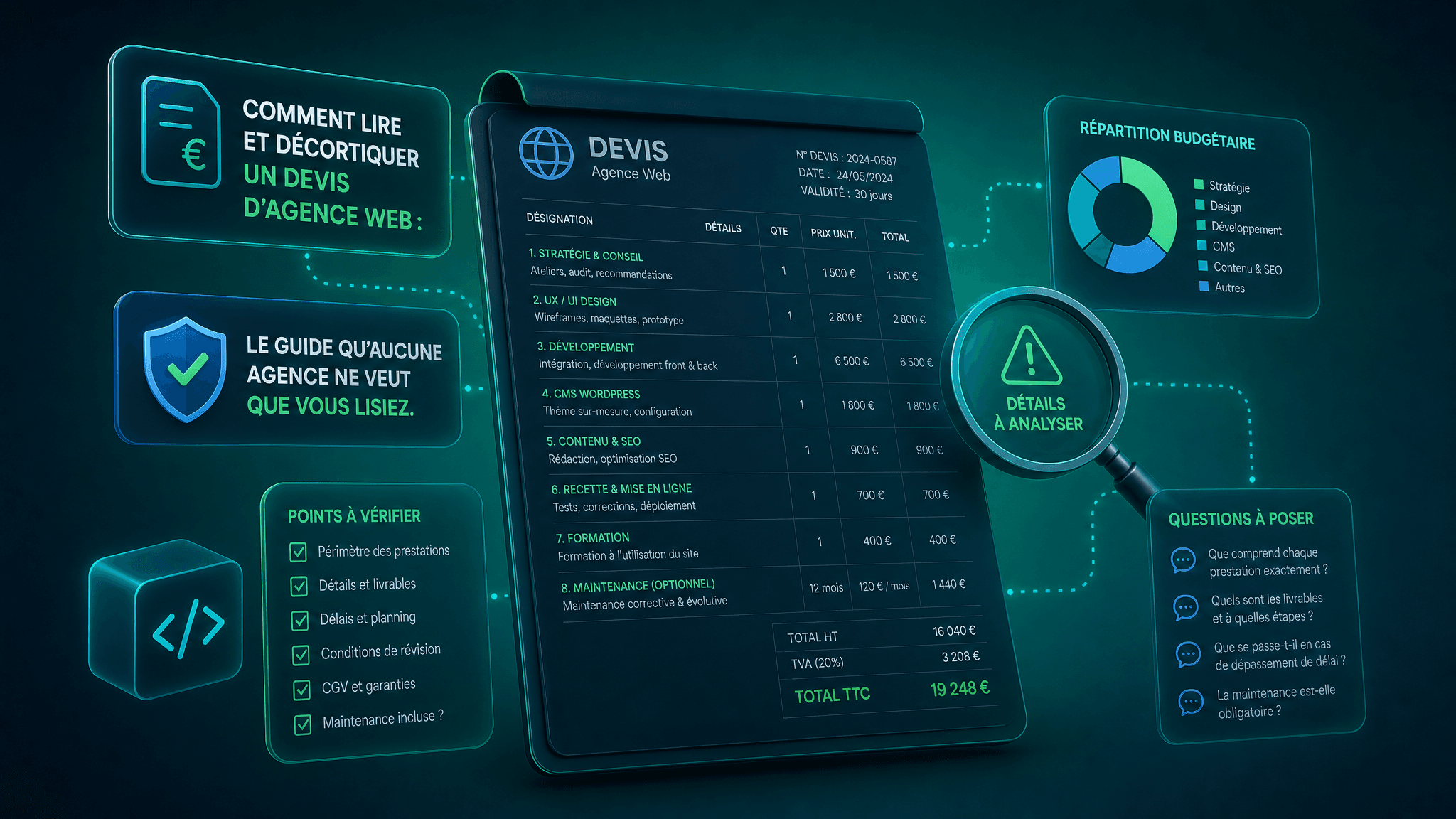
Compare the service, not just the total
A website quote should describe what will be delivered, on what terms and at what price. Different totals may cover different work. The aim is not to guess a supplier’s internal costs but to obtain a proposal detailed enough to make a decision.
Synerium offers recurring services, so our perspective is not neutral. Fixed-price projects, time-based work and subscriptions can each suit different needs, depending on scope stability, ongoing demand and the responsibilities you want to delegate.
Make eight common workstreams concrete
Ask for verifiable deliverables. A promise of a modern, optimized website is not a list of pages, features and acceptance criteria.
- Discovery and UX: objectives, audiences, site structure, journeys and design deliverables.
- Design: page templates, mobile adaptation, content inputs and included review cycles.
- Development: functions, integrations, technical constraints and existing-system migration.
- Content: writing, entry, translation, media and approval responsibility.
- Testing: browsers, business journeys, forms, accessibility and defect handling.
- Launch: hosting, domain, certificates, redirects, backups and rollback.
- Training: participants, format, documentation and access handover.
- Management: contact person, meetings, approvals, tracking and change control.
A billed day rate is not the supplier’s production cost
Days and rates per role help explain an estimate but do not reveal an agency’s actual margin. The billed rate may cover pay, software, supervision, insurance, sales time and project risk.
Markup and profit margin also use different denominators. Instead of assuming hidden margins, ask what the price covers and how scope changes are approved. Coordination is real work; there is no universal 10% project-management ceiling.
A worked example for comparing three proposals
Imagine a fictional €12,000 excluding-VAT quote: €2,000 for discovery, €2,500 for design, €5,500 for development, €1,200 for content and €800 for acceptance testing. This is an arithmetic illustration, not a market average or a real agency’s cost structure.
Before comparing it with two other proposals, check that they include the same pages, content, integrations and tests. Add recurring costs over the same period: hosting, licences, support, maintenance and planned changes. Record exclusions rather than treating missing lines as free services.
Questions to ask before signing
Who performs and approves each stage? How many review cycles are included, and what counts as a scope change? Which client dependencies can delay delivery? What response arrangements apply after launch?
Ask whether subcontractors are involved, who carries responsibility, where data is processed and who controls access. Accents, names or assumed origins do not establish competence or provide a legitimate verification method.
Clarify rights to code, designs, content and third-party components, including when rights transfer. Access to source code does not necessarily mean full ownership. Project, licensing and financing contracts can have different terms.
Plan for changes and exit
The proposal should explain how additional work is priced and approved. Agree written approval before it starts and a process for disagreements. An overrun alone does not establish who must pay; the contract and circumstances matter.
At handover, check access, exports, files, transferable licences, documentation and transition support. Review termination terms, outstanding payments and possible fees. For a dispute, seek appropriate legal advice rather than treating this guide as an automatic right to withhold payment.
One project or recurring production?
Fixed pricing suits a defined deliverable. Time-based work can support discovery, with time tracking and a budget. A subscription serves recurring requests within agreed scope and capacity. None is universally cheaper.
At Synerium, Studio is a scoped website project financed directly by Synerium over 36 months, with launch fees. Source code can be provided on request from month 12 without cancelling the remaining payments; full ownership transfers at month 36. Infinity covers recurring needs: design from Starter, marketing and SEO/GEO from Premium, development from Ultimate. Scope and active capacity depend on the selected plan. An unlimited request queue does not mean a full-time team or unlimited output. Current prices, commitments, exclusions and third-party costs are detailed on the offer pages.
See our website creation approach or discuss your project in a Studio call.