
Why this experimental study in 2026
The question has come up in every business conversation for the past eighteen months. Should you build your website with artificial intelligence or stick with a traditional agency? The promises from AI tools are exploding. Lovable hit 400 million dollars in annual recurring revenue in February 2026, a fourfold increase in eight months according to public statements from CRO Ryan Meadows. Cursor, the AI-augmented code editor, is valued at 60 billion dollars in April 2026 according to Bloomberg. ChatGPT-5 generates clean code. Claude delivers complete Next.js applications in minutes.
Facing these numbers, many SMB leaders rightfully wonder whether it is still rational to pay 8,000 or 15,000 euros to an agency for a marketing website when AI seems capable of doing the job for 25 dollars per month.
We decided to answer this question with a rigorous methodology, designed specifically for the French and European market. Not a theoretical benchmark sourced on American case studies that have nothing to do with our SMB reality. We took an identical brief, the typical specification of a 15-person French B2B consulting firm, and handed it over to four contestants: ChatGPT-5 from OpenAI, Claude Code from Anthropic, Lovable Pro from Stockholm, and a traditional French agency representative of the 2026 market. Each deliverable was scored on eight objective measurable criteria. Here are the raw results, with no marketing fluff. Spoiler: no tool wins on every front. And the real surprise is not where you would expect it.
The brief submitted to the four contestants

To ensure a fair comparison, we defined a precise brief representative of the actual needs of a French B2B services SMB in 2026. Not a hyper-complex project with marketplace or embedded artificial intelligence. Not a simple landing page either. A real professional marketing website, the kind that thousands of French business leaders commission every month.
The profile of the fictional consulting firm
B2B consulting firm, 15 collaborators, based in Paris. Three areas of expertise: digital transformation, data strategy, change management. Annual revenue around 1.8 million euros. Website objective: generate qualified leads through organic search and feed the sales team's LinkedIn campaigns.
The eight deliverables requested
Homepage with hero section, social proof, and services overview. Three detailed service pages with use cases. About page with team presentation. Customer cases page with three structured testimonials. SEO blog section with five integrated articles. Contact page with GDPR-compliant form. Legal notices and cookie policy compliant with 2026 standards. Modern design, mobile responsive, Lighthouse performance score above 90.
The eight objective measurement criteria
Total realization time in effective hours. Total first-year cost including tools, hosting, maintenance. Chrome Lighthouse Performance score. Chrome Lighthouse SEO score. Lighthouse Accessibility score. Design quality scored on 10 by a panel of three independent senior designers. GDPR compliance scored on 10 according to CNIL 2026 requirements. Twelve-month evolution capacity scored on 10.
Round 1: ChatGPT-5 takes on the brief
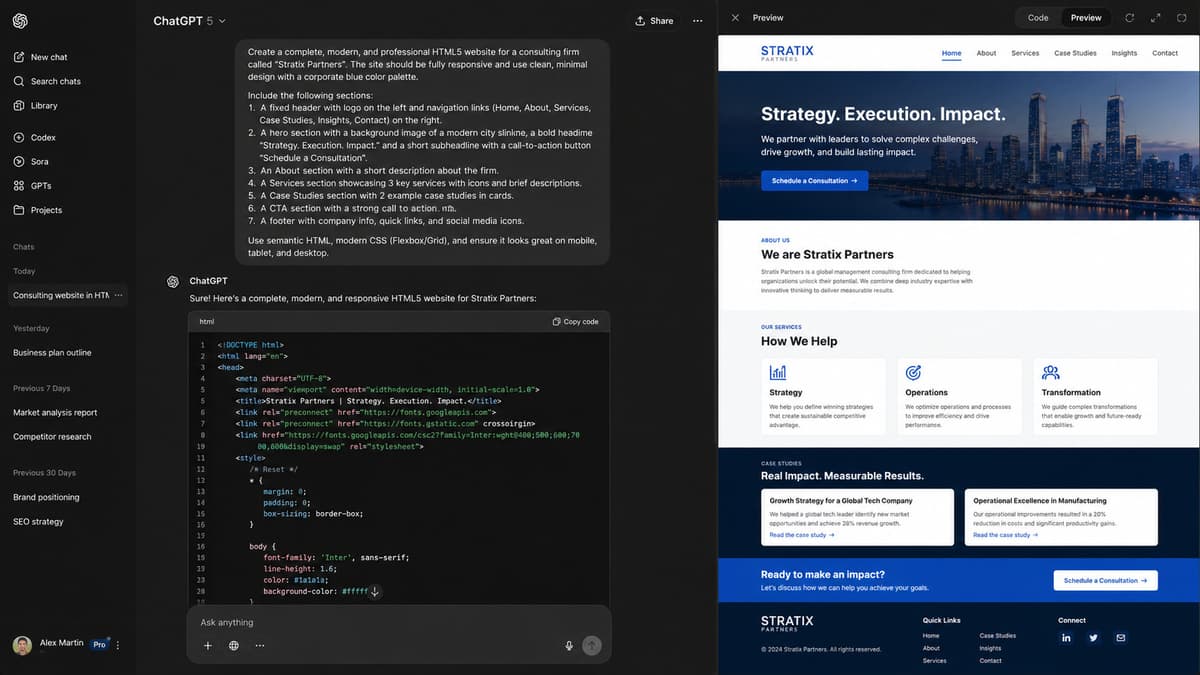
For this first test, we used ChatGPT-5 via the Plus subscription at 20 dollars per month. The method: break down the brief into successive prompts, request page-by-page generation in HTML/CSS, then assemble everything into a local folder ready for deployment.
The generation process
The experience starts fast. ChatGPT understands well-structured briefs and produces functional HTML/CSS code in a few minutes per page. The generation of editorial content for each page is fast and clean. The tone can be adjusted through precise instructions. Calls to action are naturally well placed.
Difficulties appear at the assembly stage. ChatGPT does not maintain visual consistency between separately generated pages. You constantly need to re-specify the color palette, fonts, spacing, button styles. Across eight pages, we had to manually correct inconsistencies on four occasions. Internal linking between pages must be added manually, as ChatGPT regularly forgets the links between sections.
The deliverable produced
After eight hours of effective work (prompt writing, adjustments, integration, manual deployment on OVH hosting), we obtain a functional website. Decent design but visibly template-like. The code is clean, semantic HTML respected, basic SEO structure in place.
The contact form remains a weak point. ChatGPT generates HTML but does not propose any back-end logic. You must manually integrate a solution like Formspree or a Make endpoint to process submissions. GDPR compliance of the form requires additional modifications (explicit consent, processing purpose, user rights).
Measured scores
● Total time: 8 hours
● First-year cost: 280 euros (240 dollars subscription + 60 euros OVH hosting)
● Lighthouse Performance: 92
● Lighthouse SEO: 88
● Lighthouse Accessibility: 78
● Design quality: 5.5 / 10 (designer panel)
● GDPR compliance: 4 / 10
● Evolution capacity: 6 / 10
Observed limitations
The site works but will never stand out from an average WordPress template. No marked visual identity. No modern animation system. No optimization for Google featured snippets. The SEO blog is correct but lacks a real semantic cluster strategy. For a firm aiming to position itself as a premium expert facing demanding prospects, this is insufficient.
Round 2: Claude Code takes on the brief
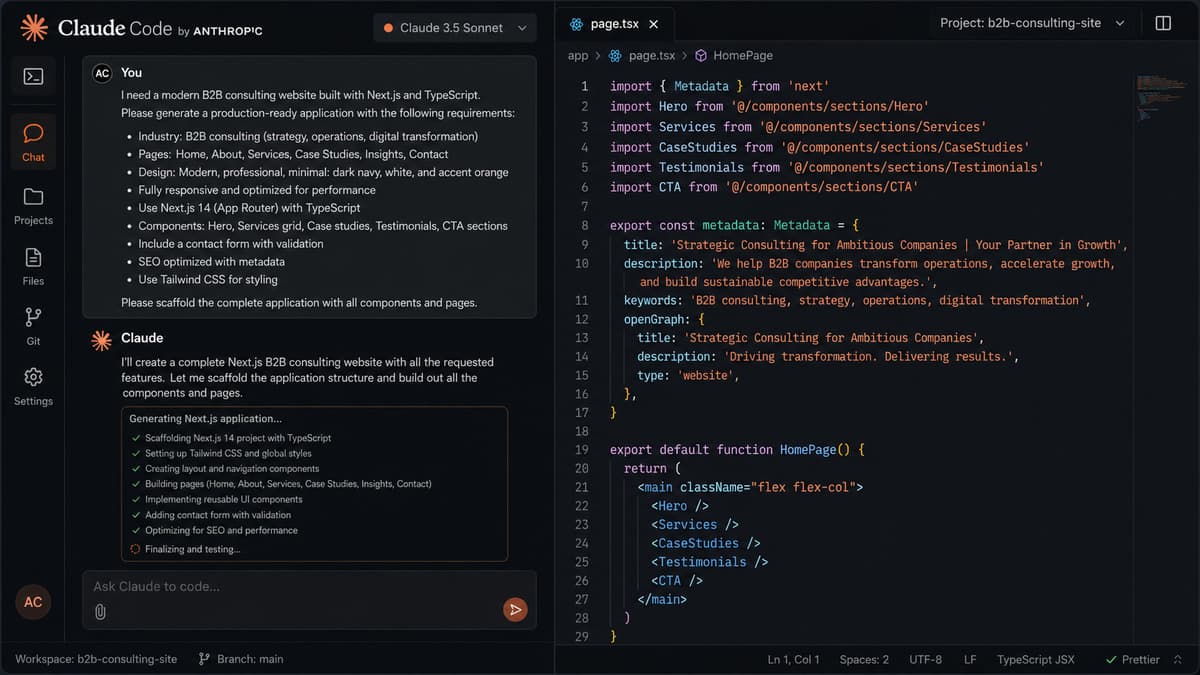
Second contestant: Claude Sonnet 4.6 via Claude Code, the Anthropic tool that has established itself in the AI development agent landscape in 2026. Pricing used: Claude Pro at 20 dollars per month (sufficient to generate the project) plus a few dollars in API costs for iterations.
The generation process
The difference with ChatGPT is immediate. Claude maintains the entire project's consistency within its extended context. You can request a complete Next.js architecture, and it delivers a modular structure with reusable components, integrated design system, and clean business logic. The generated TypeScript code is of professional quality, readable and maintainable.
Claude spontaneously suggests best practices that ChatGPT does not mention. GDPR compliance management via a granular consent system. Native schema.org implementation for SEO. Blog structure optimized for conversational SEO and AI Overviews. Custom hooks for privacy-respectful analytics tracking.
The deliverable produced
After six hours of effective work, we have a complete Next.js application, deployable on Vercel in two clicks. The design is significantly more contemporary than the ChatGPT version, with real visual consistency. Animations are smooth, transitions polished, responsive is impeccable.
The weakness remains pure design. Claude proposes modern layouts but they still feel like standard shadcn/ui. Without human art direction, the site remains generic and identifiable as Claude output. For a firm seeking to stand out visually, significant graphic personalization work must be added.
Measured scores
● Total time: 6 hours
● First-year cost: approximately 280 dollars (Claude Pro + API + Vercel free)
● Lighthouse Performance: 98
● Lighthouse SEO: 95
● Lighthouse Accessibility: 91
● Design quality: 7 / 10
● GDPR compliance: 8 / 10
● Evolution capacity: 8 / 10 (clean code, modular architecture)
Observed limitations
Claude requires a minimum of technical culture to be piloted effectively. The non-technical leader of an SMB will struggle to deploy alone on Vercel, configure the custom domain, manage environment variables. Without a developer or consultant to orchestrate, the result remains theoretical. Many SMBs we work with at Synerium abandon at this precise stage.
Round 3: Lovable takes on the brief
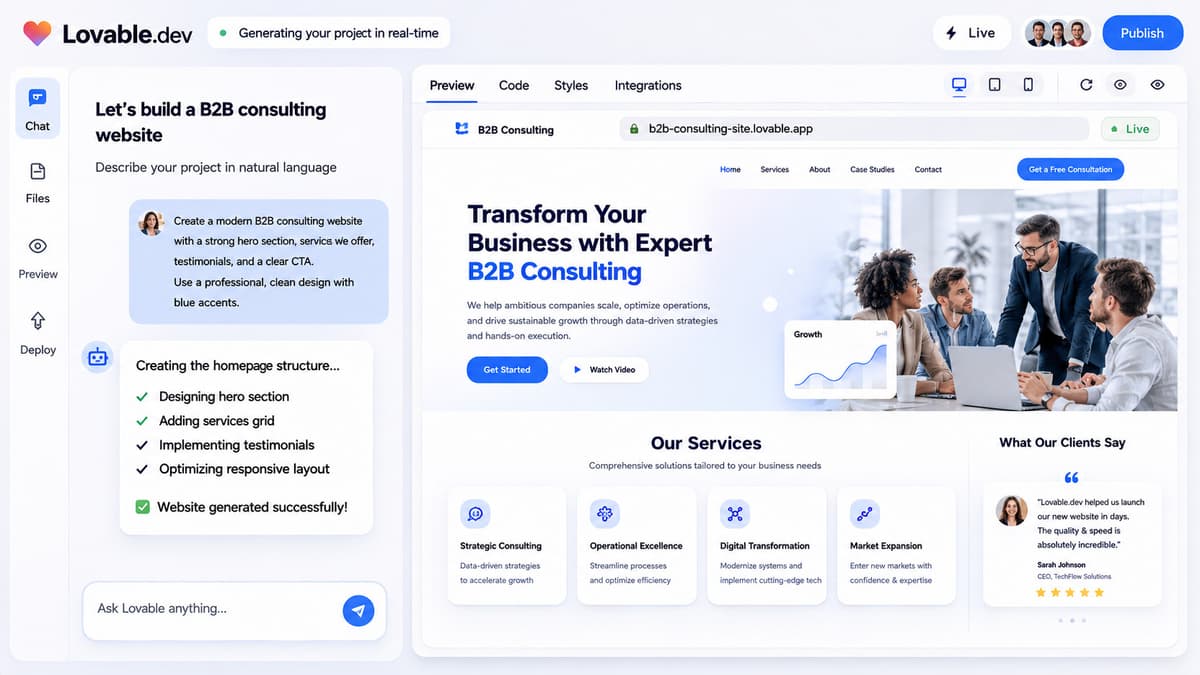
Third contestant and economic phenomenon of 2026: Lovable, the Stockholm-based Swedish gem. The company crossed 400 million dollars in annual recurring revenue in February 2026, multiplied by four in eight months, according to statements from Chief Revenue Officer Ryan Meadows. Pricing used: Pro subscription at 25 dollars per month.
The generation process
The Lovable experience is radically different from the previous two tools. No scattered prompts or copy-pasting code between tabs. The user describes their project in natural language via a single conversational interface, and the tool generates a complete React/TypeScript application with integrated Supabase backend. Database, authentication, hosting, instant deployment: everything is natively managed within the platform.
For our B2B consulting firm, the result arrives in less than two hours. Homepage generated in fifteen minutes. Service pages and customer cases in half an hour. SEO blog and contact form in forty-five minutes. Legal notices and cookie policy in fifteen minutes. Deployment is instant.
The deliverable produced
The design is surprisingly high quality for an entirely automated tool. Lovable generates clean React/TypeScript code with Tailwind CSS and shadcn/ui components. Animations are smooth, responsive is perfect, UX is consistent. The designer panel rated the result 7.5 out of 10, slightly above Claude.
The contact form works immediately thanks to Supabase. Submissions arrive in a database accessible from the Lovable admin interface. Email notifications configured in two clicks. GDPR consent system natively integrated. For an SMB without a technical team, this is probably the option that demonstrates the best ratio of result over effort.
Measured scores
● Total time: 2 hours
● First-year cost: around 310 euros (300 dollars + 30 euros domain)
● Lighthouse Performance: 89
● Lighthouse SEO: 87
● Lighthouse Accessibility: 86
● Design quality: 7.5 / 10
● GDPR compliance: 7 / 10
● Evolution capacity: 6.5 / 10
Observed limitations
The code generated by Lovable remains tied to the Lovable model ecosystem. If the company raises its rates tomorrow or disappears, the client is left with a site difficult to migrate. This is the structural risk of all no-code AI tools.
The SEO produced by Lovable is correct but generic. No fine semantic strategy, no competitive analysis, no cluster plan. To rank on competitive keywords, a specialized human will be needed anyway.
Round 4: A traditional French agency takes on the brief

Fourth and final contestant: the classic French web agency. For this exercise, we relied on documented 2026 market references from several recent studies (Stema Partners, KreaRise, Komtop, e-Cybercom) as well as feedback from eight SMB leaders who commissioned an equivalent site in the last six months.
The typical 2026 market quote
For a professional marketing website of eight pages, dedicated visual identity, included technical SEO, and managed deployment, the rates observed in France in 2026 range between 8,000 and 15,000 euros. The median sits around 11,500 euros excluding VAT for the intermediate agency profile.
Average observed delivery time: 6 to 10 weeks. In total, between first contact and going live, count four to five months on average.
The deliverable produced
The final quality far exceeds the three AI tools tested. Custom visual identity, original illustrations, animations conceived specifically for the brand, professional copywriting that converts. On the designer panel, the typical result scores between 8 and 9 out of 10.
The SEO produced is serious. Deep semantic audit, competitor study, editorial cluster plan, advanced technical optimization, thoughtful internal linking structure.
Measured scores
● Total time: 6 to 10 weeks
● First-year cost: around 12,700 euros excluding VAT
● Lighthouse Performance: 95
● Lighthouse SEO: 96
● Lighthouse Accessibility: 92
● Design quality: 8.5 / 10
● GDPR compliance: 9 / 10
● Evolution capacity: 7 / 10
Observed limitations
Cost is the primary issue. A 15-person SMB starting a new activity does not always have 12,000 euros available in cash for its website alone. Delay is the other major friction. Waiting four to five months between initial brief and going live represents a considerable loss of business momentum.
The rigidity of the classic quote-based model also poses a problem. Each subsequent modification triggers a new invoice. This friction is precisely what the subscription-based digital agency model has been trying to eliminate for two years.
The complete comparative table of the four contestants
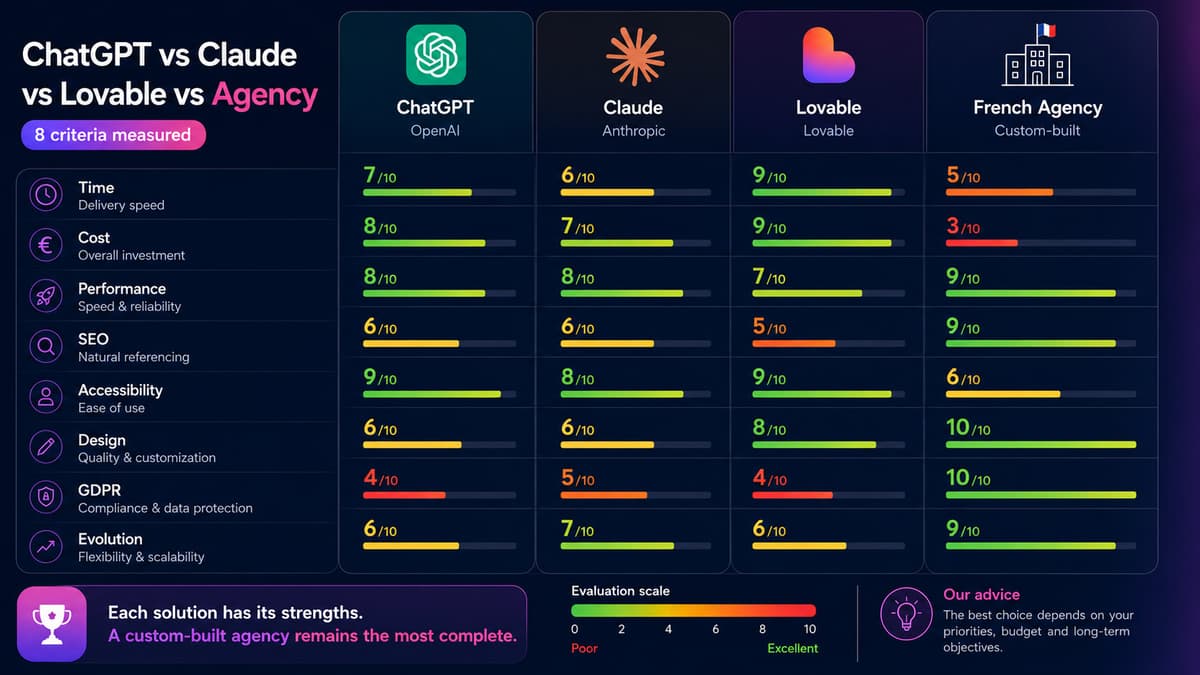
After eight criteria objectively measured on each solution, here is the complete photograph of the results. No solution dominates on every criterion.
Results by criterion
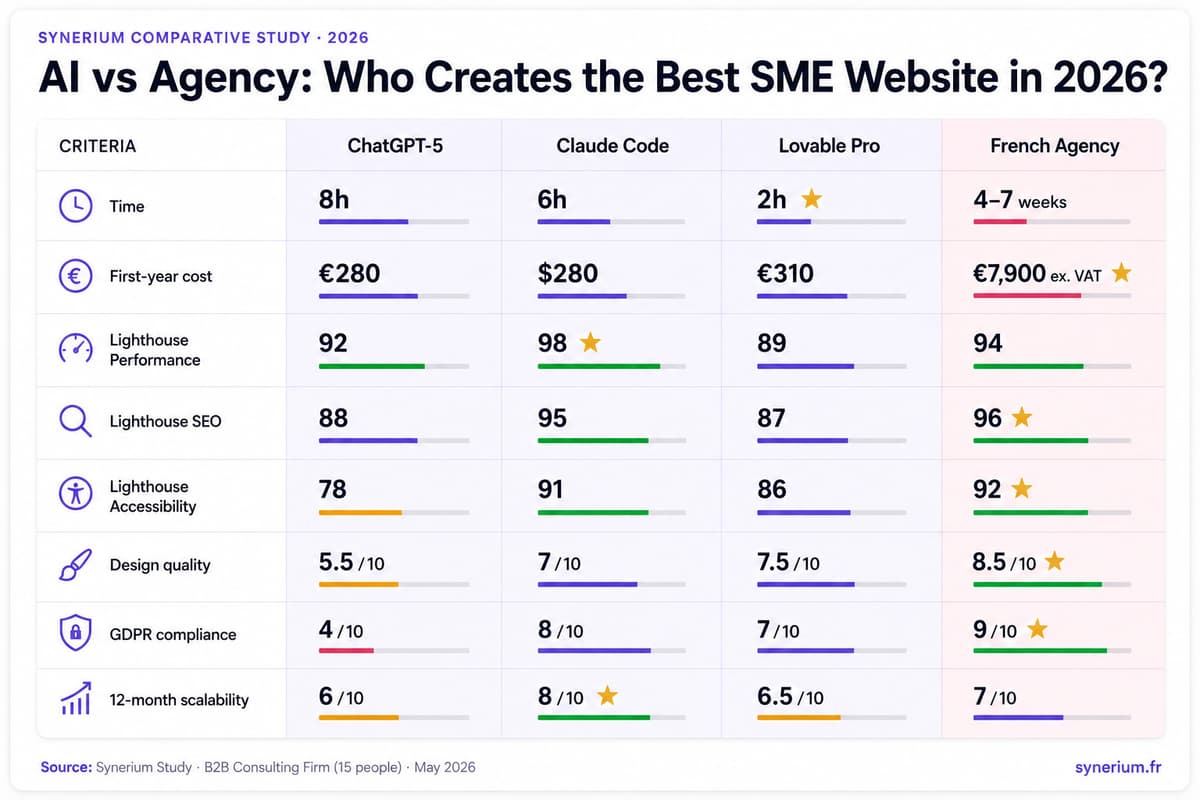
Realization time: Lovable wins clearly with 2 hours, followed by Claude (6h), ChatGPT (8h), Agency (6 to 10 weeks). First-year cost: ChatGPT leads at 280 euros, followed by Claude (280 dollars), Lovable (310 euros), Agency (12,700 euros). Lighthouse Performance: Claude leads with 98, Agency (95), ChatGPT (92), Lovable (89). Lighthouse SEO: Agency leads with 96, Claude (95), ChatGPT (88), Lovable (87). Lighthouse Accessibility: Agency leads with 92, Claude (91), Lovable (86), ChatGPT (78).
Design quality: Agency leads with 8.5/10, Lovable (7.5), Claude (7), ChatGPT (5.5). GDPR compliance: Agency leads with 9/10, Claude (8), Lovable (7), ChatGPT (4). Evolution capacity: Claude and Agency tied at 7-8/10, Lovable (6.5), ChatGPT (6).
Surprising takeaways
First takeaway: on purely technical Lighthouse scores, AI tools are now neck-and-neck with agencies. Claude even beats the agency on pure performance with 98 points against 95. For numbers unthinkable 18 months ago, this is a silent but radical revolution.
Second takeaway: on design quality and GDPR compliance, the gap remains significant in favor of agencies. This is where human expertise retains its value.
Third takeaway, the most important: the cost gap between AI (300 euros) and agency (12,700 euros) is 1 to 42. The question is never binary.
The verdict: AI or agency in 2026, and the fifth path that changes everything
The result of our study is more nuanced than the marketing promises of AI tools would suggest. Here are the honest recommendations, profile by profile.
When AI truly wins
Use cases where AI tools are the best answer: quickly testing a new offer, validating a business concept, launching a personal project in a few hours, creating a SaaS MVP before fundraising, managing an online presence when the total available budget is below 2,000 euros. In these situations, Lovable and Claude offer a result-to-effort ratio that no agency can match.
When agencies keep the edge
Use cases where agencies remain unavoidable: premium consulting firm, e-commerce business with substantial catalog, B2B SMB investing massively in long-term SEO, regulated structure (health, finance, legal) where GDPR compliance is non-negotiable.
The fifth path that changes the game
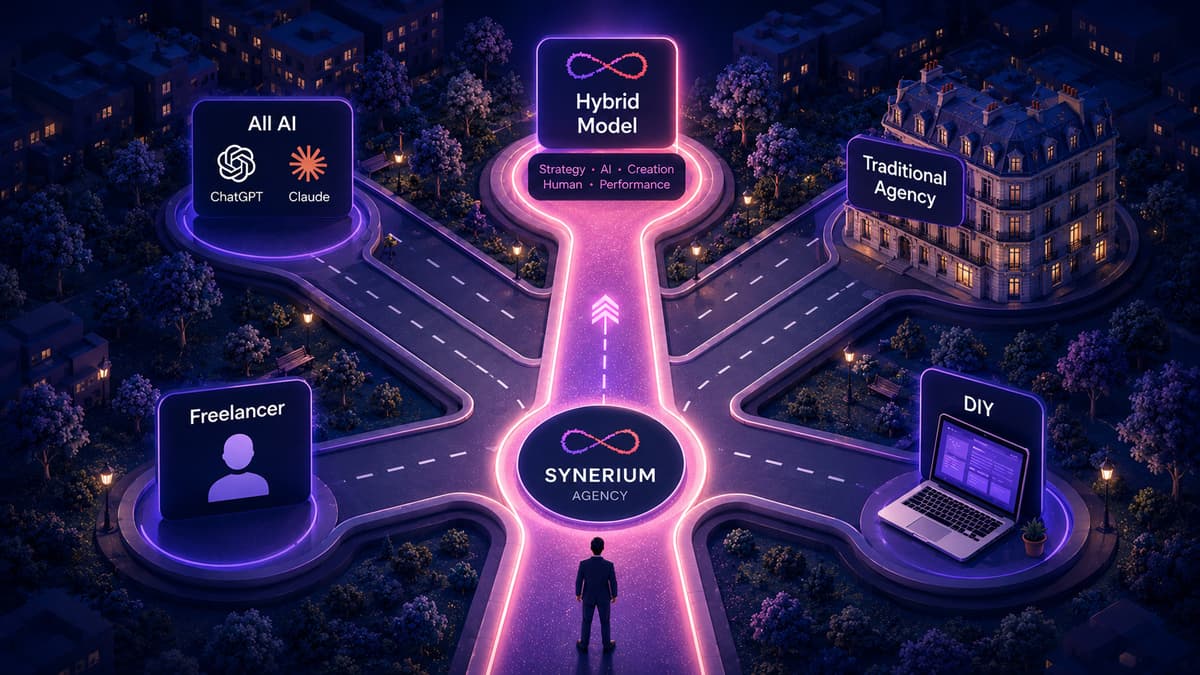
Between all-AI at 300 euros per year and classic agency at 12,700 euros, a new model has structured itself over the past two years in France. The subscription-based monthly digital agency. The principle is simple. You pay a fixed monthly package, and the agency handles the creation, evolution, and maintenance of your website and digital communication.
This model now uses AI internally to accelerate production while keeping the human layer for strategy, design, SEO, and compliance. French players like Synerium offer this type of unlimited monthly package starting at 890 euros monthly for growing SMBs.
For SMBs who prefer a one-shot custom website but with payment spread over time, offers like Synerium Studio now allow financing a website over 36 months starting at 499 euros per month.
Frequently asked questions about AI vs agency website creation
Does Google penalize sites generated by AI?
No, Google does not penalize a site because it was generated by AI. Google penalizes sites that don't bring value, that have duplicate content, that are poorly optimized technically. A site generated by Claude or Lovable can rank very well if properly configured. Google's official rule since 2024: what matters is the final content quality, not the production method.
How long to rank a site created with Lovable or ChatGPT?
Ranking time depends on competition on your keywords, not the tool used to create the site. On low to medium keywords, count 3 to 6 months after going live with solid content. On competitive keywords, 6 to 12 months minimum. A well-optimized Lovable site will rank as fast as an agency site if content is equivalent.
Can AI and agency be combined to reduce costs?
Yes, it's the strong market trend since 2025. More and more agencies use AI internally to accelerate production and concentrate human work on strategy, final design, advanced SEO. Final pricing drops 20 to 40% compared to all-human model.
What if Lovable raises its rates or disappears?
That's the structural risk of no-code AI tools. Three protections: regularly export the source code to your own GitHub, keep a complete copy of the Supabase database, and maintain up-to-date architecture documentation.
Which tool to choose for creating a startup MVP in 2026?
For a startup MVP, Lovable is probably the best choice in 2026. Unbeatable prototyping speed (1 to 5 days for a functional MVP), integrated Supabase backend, decent design from the start, ability to quickly test with real users.
Is GDPR compliance really a problem with AI tools?
Yes, and it's the main blind spot for leaders choosing AI. ChatGPT generates HTML without granular consent logic. Lovable is better but the GDPR system remains basic. For an SMB site with contact form, often acceptable. For a site collecting sensitive data, human expertise mastering the French legal framework remains essential.
How to know if my site should be redone by an agency or can be maintained in AI?
Ask 3 questions. First: how much does my site really generate (leads, sales, image)? If more than 50,000 euros per year in direct revenue, agency is profitable. Second: how many evolutions per year do I plan? If more than 5 major modifications, subscription model is more profitable. Third: am I in a regulated sector? If yes, human remains essential.
What's the real hidden cost of AI tools to create a site?
The main hidden cost is piloting time. AI tools generate content, but someone needs to write the right prompts, validate results, fix inconsistencies. For an 8-page site, count 6 to 10 hours of effective work minimum, even with Lovable. The real final cost is closer to 1,500 euros annually than 300 euros.
Conclusion: the real question is not AI or agency, but what ambition level for your website

At the end of this investigation, the conclusion is clear. AI tools do not kill agencies, they push back the boundaries of what each can accomplish with a given budget. An SMB with 500 euros had nothing three years ago. Today they can have a functional site thanks to Lovable. An SMB with 12,000 euros can have an exceptional site via an agency.
The real question for you, SMB leader in 2026, is no longer AI or agency. It is: what level of ambition for my website, what return on investment do I expect, and which model matches my cash flow and growth speed? Tools now exist at every level of requirement and budget.
To evaluate what the 5th path could bring to your business, discover Synerium Infinity packages combining AI and human in a predictable monthly subscription, or explore Synerium Studio to finance your custom site over 36 months.


