Case study · Synerium Studio
Adheazy B2C and B2B e-commerce for premium adhesive coverings
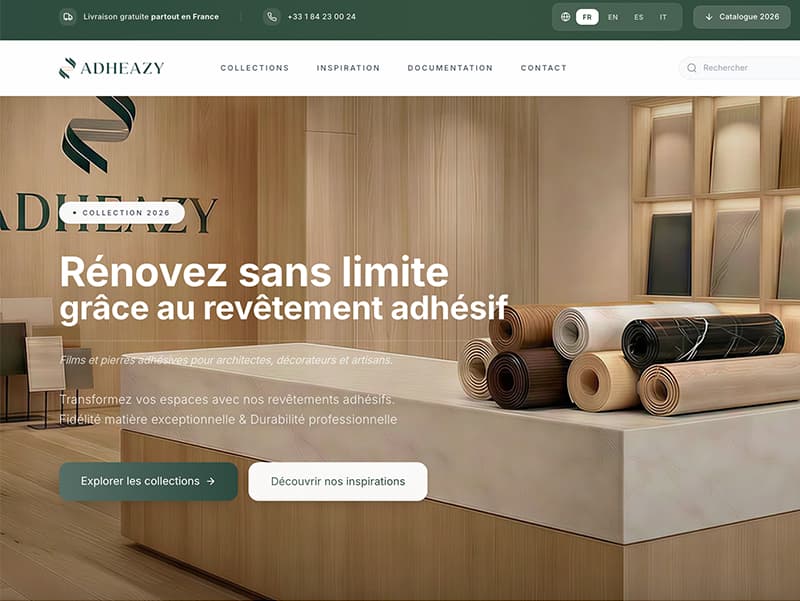
A sub-brand of Reflectiv entrusted by Jean-Charles Doll. End-to-end creation of a complete e-commerce platform dedicated to decorative adhesive coverings, simultaneously managing consumers and professionals, with a 3D configurator and multiple payment solutions.
- Languages
- 4 FR · EN · ES · IT
- Payments
- 4 Stripe · PayPal · bank transfer · SEPA
- Architecture
- React React + Symfony
The project at a glance
Explore the material. Move towards purchase.
Adhesive coverings are chosen visually, but ordering them involves practical constraints. Adheazy combines inspiration, 3D visualisation and journeys for consumers and professionals.
See before choosing
3D visualisation helps buyers inspect materials and details directly in the browser.
Two audiences, one site
Consumers and professionals find journeys and terms suited to their profiles.
Buy on suitable terms
Samples and payment options support the decision through to the order.
01 · The challenge
Creating a premium e-commerce platform that speaks to both consumers and professionals
Adheazy is a sub-brand of Reflectiv, a French adhesive film manufacturer with 40 years of experience. After the complete redesign of the Reflectiv platform, Jean-Charles Doll entrusted us with a new mission: creating Adheazy from the ground up, both as a brand and as an e-commerce platform entirely dedicated to decorative adhesive coverings. While Reflectiv addresses industrial professional markets, Adheazy has a broader positioning: consumers who want to renovate their spaces without construction work, and professionals such as architects, decorators and installers looking for wood, marble, concrete, metal and stone-effect adhesive coverings with exceptional realism.
The challenge was significant. The platform had to handle two audiences with radically different needs on a single website. A consumer buying one roll of decorative film for a kitchen does not have the same expectations as a decorator placing regular volume orders with specific pricing conditions. We had to design a journey adapted to both audiences, without one getting in the way of the other, and without multiplying websites.
There was also a strong product challenge: how do you communicate the quality and realism of an adhesive covering online, especially adhesive stone? Photos alone are not enough. A customer who cannot touch the product needs to see it from every angle, in realistic conditions, before buying. The answer to that question became the central feature of the project.
Payment management added another layer of complexity. On one site, we had to offer solutions for consumers paying per order, and professionals using direct debit or bank transfer. Each payment method had to appear at the right time, for the right profile, without making the experience heavier for customers who do not need those options.
02 · The work
From the first impression to the right action.

What was delivered
- 01React + Symfony e-commerce platform
- 02Real-time 3D rotation configurator with Three.js
- 03Automatic simultaneous B2C and B2B management
- 04Professional portal with dedicated pricing
- 05Sample order module
- 06Stripe and PayPal integration
- 07Bank transfer and direct debit for professionals
- 08Multi-format product catalogue with PDF download
- 09Multilingual site: FR, EN, ES, IT
- 10Checkout optimised by client type
- 11Premium design system consistent with Adheazy's identity
03 · The solution
A React e-commerce platform with 3D configurator and integrated B2B and B2C management
Our e-commerce creation approachThe Adheazy platform was developed with React on the frontend and Symfony on the backend. This architecture brings the responsiveness and fluidity of a modern web application while relying on a robust backend to manage orders, customer accounts and differentiated pricing logic. React makes it possible to render complex interfaces such as the 3D configurator without page reloads, with smooth transitions that reinforce the product's perceived quality.
Simultaneous B2C and B2B management sits at the heart of the system. The site automatically detects the customer type at login and adapts the experience accordingly. A consumer sees VAT-inclusive pricing, a simplified checkout and interior-decoration-oriented product suggestions. A professional accesses negotiated pricing, specific payment conditions, order history and the ability to order samples before validating a volume order. Two distinct experiences, one platform.
The Three.js 3D configurator is the flagship feature of the project. It lets every visitor view Adheazy adhesive stones in full rotation, from every angle and under different lighting conditions. Textures, veins and material effects are rendered with a level of realism that faithfully reproduces the visual behaviour of each stone. Being able to rotate the product before buying directly answers the question every online buyer has: will this product really look like this in my space?
Payment solutions were designed to cover every buyer profile. Consumers pay by card through Stripe or via PayPal. Professionals also have access to bank transfer and direct debit for recurring orders. Each payment method is presented at the right moment in the checkout according to the authenticated customer type.
Inside the project
A B2B B2C e-commerce platform with a 3D configurator built to convert
The Three.js 3D configurator: viewing adhesive stones from every angle
For a product like adhesive stone, the purchase decision is made visually. The Three.js configurator lets every visitor rotate Adheazy adhesive stones in every direction, observe textures and veins from different angles and under different lighting conditions. The rendering faithfully reproduces the visual behaviour of each material: the natural irregularity of stone, the surface relief and the colour variations depending on light direction.
Three.js is the reference WebGL library for 3D rendering in a browser. It loads 3D models, applies high-resolution textures and manages real-time lighting directly on the client side, without plugins or downloaded applications. For Adheazy, each adhesive stone is modelled with its real physical properties: roughness, reflection and light absorption. The result is a photorealistic render accessible from any modern browser, on desktop and mobile.
For a consumer hesitating between two finishes for a living room, this can be the difference between an uncertain decision and a confident order. For an architect or decorator validating a material choice with a client, it becomes a professional presentation tool integrated directly into the purchasing platform. The 3D view answers the first questions before the customer even contacts sales or orders samples.
Performance optimisation for the configurator was a project in itself. 3D models and textures load progressively so they do not penalise the initial page load. Rendering is optimised to stay smooth on every device, including mobile where graphics resources are more limited.
React and Symfony architecture: performance and clear responsibilities
The choice of a decoupled React and Symfony architecture was deliberate. React handles the entire client-side user interface: navigation, product display, 3D configurator, checkout and customer area. Symfony handles server-side business logic, database operations, B2B pricing rules, payment integrations and communication with carriers.
This separation brings concrete advantages. Perceived performance is significantly better than on a traditional e-commerce site: page transitions are instant, the 3D configurator responds immediately and the checkout never reloads the entire page. On the backend, Symfony provides a solid structure for business code, fine-grained access management between B2C and B2B accounts, and a robust API serving data to the React frontend.
The REST API developed with Symfony exposes product data, pricing, orders and customer information to the React frontend securely. Every call is authenticated, and sensitive data such as negotiated professional pricing is never exposed client-side without checking the user profile.
Automatic B2C and B2B management on one e-commerce platform
One of the most complex technical challenges on Adheazy was managing two radically different purchasing logics in a single codebase. The solution relies on automatic customer profile detection at login. A consumer account and a professional account do not see the same site, even though they navigate the same URL.
On the B2C side, the experience is designed for discovery and inspiration. Collections are staged, interior moods are highlighted and the 3D configurator is accessible in a few clicks. The checkout is simplified as much as possible to reduce friction between intent and order.
On the B2B side, efficiency comes first. A professional returning regularly to Adheazy wants fast access to usual products, negotiated pricing without calling sales, and the ability to finalise an order in minutes. The professional area centralises order history, specific pricing conditions and sample management.
Professional pricing management is one of the most complex parts of the project. Each professional customer has pricing conditions defined by purchase volume and commercial relationship with Adheazy. The Symfony backend manages this complexity transparently: professionals see their prices as soon as they log in, without needing to request a quote.
Payment solutions adapted to each customer profile
Payment management on Adheazy covers all use cases. Stripe handles card payments, PayPal supports customers who prefer that method, bank transfer covers professionals managing purchases through accounting, and direct debit supports professional customers with recurring orders.
Stripe integration manages the full consumer payment cycle: payment form display, 3D Secure validation, order confirmation and potential refunds. For professionals, SEPA direct debit creates a smoother commercial relationship without administrative friction on every order. Invoices are generated automatically and made available in the professional customer area.
Each payment method is offered at the right moment according to the authenticated customer profile, without weighing down checkout for users who do not need it. A consumer does not see bank transfer options. A professional does not see the PayPal button. Display logic is handled server-side and passed to React through the API.
A multilingual e-commerce site in 4 languages
Adheazy is available in French, English, Spanish and Italian. Each language version was developed with careful attention to the user experience in that language. The 3D configurator, product pages, B2C and B2B checkouts and customer areas work identically across the four languages.
Multilingual management in the React application relies on an integrated internationalisation system. Translations load dynamically according to the selected language, without a page reload. URLs are adapted per language for organic search. Hreflang tags indicate the relationship between language versions of each page to Google, avoiding duplicate-content issues across international markets.
What is a 3D configurator for an adhesive covering e-commerce site?
The Adheazy 3D configurator lets every visitor view adhesive stones in full rotation, from every angle and under different lighting conditions. Built with Three.js, it faithfully renders textures and material effects directly in the browser, without plugins or a downloaded application. 3D models include the real physical properties of each material: roughness, reflection and light absorption. It reduces purchase hesitation and improves conversion on products that sell primarily through their visual appearance.
How do you manage B2C and B2B on the same e-commerce site?
The Adheazy platform automatically detects the customer type at login and adapts the experience accordingly. Consumers and professionals see different interfaces, different pricing and different payment options on the same site. Differentiation logic is handled by the Symfony backend and passed to the React frontend through a secure API. This avoids multiplying platforms while guaranteeing an experience adapted to each buyer type.
Which payment solutions can be integrated into a B2B and B2C e-commerce site?
On Adheazy, four payment methods were integrated: Stripe for card payments, PayPal, bank transfer and SEPA direct debit for professionals. Each method is offered according to the authenticated customer profile. Consumers see Stripe and PayPal. Professionals also access bank transfer and direct debit for recurring orders, with automatic invoice generation in their customer area.
Can you create a B2B customer area with professional pricing on a React e-commerce site?
Yes. The Adheazy professional area includes negotiated pricing per customer, order history, sample ordering and payment options dedicated to professionals. Everything is managed from the Symfony backend and presented transparently to the logged-in professional customer, without needing to contact sales to know their conditions.
Why choose React for an e-commerce website?
React makes it possible to build complex, highly responsive user interfaces with instant page transitions and interactive components such as the 3D configurator. Unlike a traditional e-commerce CMS, React never reloads the entire page, which significantly improves perceived speed and user experience. Coupled with a robust Symfony backend, it is especially well suited to e-commerce platforms requiring advanced features such as simultaneous B2C and B2B management.
Is Three.js suitable for a product configurator on an e-commerce site?
Three.js is the reference JavaScript library for 3D rendering in a browser. For Adheazy, it makes it possible to rotate adhesive stones in real time with a high level of realism, managing lighting, textures and the physical properties of each material directly in the browser. Performance is optimised to work across devices, including mobile, thanks to progressive loading of 3D assets.
How do you optimise performance on a React e-commerce site with 3D?
Performance optimisation on Adheazy covered several areas. Progressive loading of 3D models and high-resolution textures avoids penalising initial page load. Three.js rendering adapts graphic quality to device capabilities. API calls to the Symfony backend are cached to reduce response times for data that changes rarely, such as the product catalogue or professional pricing.
Is the e-commerce site mobile-friendly?
Yes. The Adheazy platform is fully responsive. The 3D configurator, product pages, B2C and B2B checkouts and customer areas work on every device. Three.js rendering is adapted to mobile graphics capabilities to maintain acceptable smoothness on all devices. This is a non-negotiable criterion on every Synerium project.
Can the platform evolve after delivery?
Yes. With a Studio plan, the platform continues to evolve every month through the included credits. New collections, new features, technical optimisation and checkout adjustments can be added over time. An e-commerce platform is never frozen.
Next project
Just In Print
Print and digital product catalogue for a manufacturer of printable adhesive films.
A similar project?
Your products deserve more than a basic product page.
Product visualisation, B2B and B2C sales or specific payment options: let’s build a journey around your customers. Studio helps define the build and ongoing evolution of your website.
30-minute video call · No commitment