
A customer adds a product, starts ordering, then disappears. The tempting response is an email followed by a discount code. But if no carrier served their address, you merely offer the same problem at a lower price.
To reduce cart abandonment, first identify where and why the journey stops. Then check fees, requested information, delivery and payment on a real phone. Reminders follow that diagnosis; they do not replace it.
Before a campaign or year-end sales, this work often deserves priority over adding paid traffic. It helps establish whether the shop is ready for the visitors you plan to bring.
An abandoned basket is not always a lost sale
Visitors fill baskets to compare, calculate totals or prepare later purchases. Baymard’s research distinguishes lack of immediate buying intent from checkout obstacles such as extra costs, account creation or complexity. Its studies provide reference points, not your shop’s diagnosis. Read Baymard’s research on abandonment reasons.
Do not treat every basket as an order owed to you. A visitor from a broad advertisement has different intent from a returning customer buying a familiar reference. An expensive or technical product may take several visits.
The first useful comparison is between comparable journeys: mobile or desktop, new or existing customers, the same delivery country and traffic source. An overall rate can hide an error affecting only some buyers.
Verify measurement before changing the site
Ask what the dashboard calls an “abandoned basket”. Is it a created basket, a session with an add, a user who added an item or a started payment? The answer changes the calculation.
In GA4, add_to_cart, begin_checkout, add_shipping_info, add_payment_info and purchase describe different moments. They must be configured and tested; being listed in documentation does not mean they already work on your site. Google’s e-commerce measurement documentation.
A calculation example, not a client result: you track 100 baskets created in a period. After the same observation time, 35 become orders. Abandonment is 65%. If repeated “Add to basket” clicks form the denominator, you are measuring something different.
Then reconcile a few orders between the back-office, payment provider and Analytics. Look for a missing purchase, duplicate event or incorrect amount. A stable transaction identifier helps deduplicate purchases; Google provides a tracking validation procedure. Validate e-commerce events.
Tracking refusal, some blockers and purchases across devices limit Analytics. A missing event therefore does not, on its own, prove a missing order. If data does not agree, start by making journey tracking reliable, without changing visitors’ consent choices.
Locate the obstacle with a complete order
Replay the journey as a new customer: from a product page, with a realistic address, on a phone and without an already signed-in account. Use your solution’s test modes to avoid creating a billable order. Record the stages and errors.
| The journey stops… | Check first |
|---|---|
| Before leaving the basket | Unclear final price or variant, an over-prominent promo code or hard-to-find button. |
| While entering details | Mandatory account, unnecessary fields, format error or unsuitable mobile keyboard. |
| When choosing delivery | Late fees, vague timing, unserved country or no available carrier. |
| At payment | Expected method missing, failed authentication, unclear error or basket lost on return. |
| After payment | Missing confirmation, inconsistent order state or purchase missing from measurement. |
A standard-order test is not enough. Try another variant, quantity, mixed basket and address outside your usual area. Weight or format errors can stay invisible if you always test the same product.
Make product choice as clear as payment
Some doubts appear in the basket but start on the product page: is this the right size? Is the price per unit or pack? Is the essential accessory included? Buyers hesitate because they are unsure what will arrive.
The Reflectiv project illustrates this earlier work: the product page lets buyers choose dimensions and see the corresponding price. The basket summary must retain that precision. Customers should not have to remember a choice made two screens earlier.
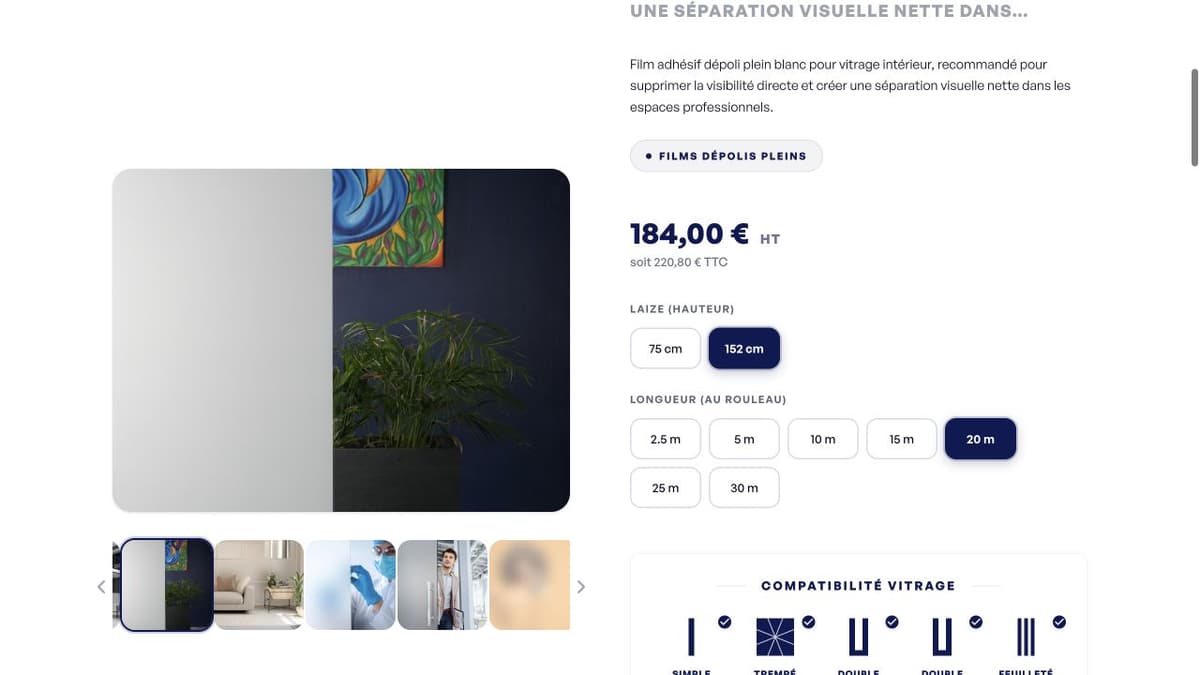
This project illustrates a design principle. It cannot, alone, attribute a conversion increase to a particular feature. Measuring that effect on your site needs appropriate tracking and comparison.
Fix friction before funding a discount
Start with definite defects: an unresponsive button, impossible delivery that should be available, inconsistent total or field validation rejecting a correct address. These problems need no marketing experiment before being fixed.
Next come presentation hypotheses. Showing delivery terms earlier, making guest checkout more visible where offered, explaining errors beside the relevant field or preserving a basket after failure are options to test on your site.
Record each change’s date and avoid changing price, campaign and every screen simultaneously. With few orders, daily fluctuations mislead. An A/B test may lack volume; observed journeys and customer feedback remain valuable. Do not turn an improvement across a few sales into a general promise.
Track paid orders and margin, not just conversion. A systematic discount can increase purchases while worsening campaign economics.
Use reminders to answer hesitation
Once the journey works, a reminder can recall the basket, answer a delivery question or offer help. Avoid invented urgency and unverified stock claims. A precise message about the product and its use is more credible than automatic pressure.
First check that sending is authorised. The CNIL distinguishes relationship messages from direct marketing; a message pushing a purchase can fall into the latter category. Simply creating an account is not enough to apply the exception for some existing customers. Content and the recipient’s situation matter. Read the CNIL rules on electronic communications (in French).
Have the scenario checked too: does the reminder stop after purchase? Does the link restore the right items? What happens when a variant is unavailable? Basket data can make a message useful, not promise something the shop can no longer deliver.
Choose between a targeted fix and a rebuild
A shipping-fee error does not require rebuilding the whole site. A heavy form can sometimes be simplified in the existing tool. However, if pricing, stock and ordering rules contradict one another, a more structured revision deserves consideration.
Prepare three things before speaking to an agency: stages where you see drop-off, two or three reproducible journeys and tools used for sales and shipping. This lets you discuss a real problem instead of commissioning a blind redesign.
At Synerium, we can review the journey with you and scope the fixes or project to consider. Let’s discuss your shop on a video call. If the diagnosis justifies broader work, explore our redesign approach. The goal stays the same: let customers complete orders they have good reasons to place.

